Planning a custom home or major remodel in Phoenix requires making one massive choice right out of the gate. Local homeowners constantly weigh design build vs traditional construction to see which model best fits their timeline, budget, and sanity. Navigating the unpredictable desert climate, strict HOA guidelines, and local permitting requirements makes this choice even more critical. Understanding the complete design build process is essential before breaking ground in the Valley of the Sun.
For decades, the standard approach was to hire an architect, finalize the blueprints, and then shop those plans around to various general contractors. Today, an integrated, single-source approach is changing how Phoenix builds. Let us dive into exactly how these models compare, what they cost in 2026, and which framework will ensure your next project crosses the finish line on time.
Design-Build vs. Traditional Contracting: Key Differences Explained
To make the best decision for your upcoming build, you first need to understand the fundamental mechanics of both methods. The traditional model, often called design-bid-build, requires you to manage two entirely separate entities. You hire an architect to draw up the plans, and once those are complete, you put the project out to bid to find a general contractor. This sequential process means the builder has no input during the design phase, which frequently leads to designs that look beautiful on paper but exceed your actual construction budget.
Conversely, the design build process brings everyone under one roof from day one. You sign a single contract with an integrated team of architects, designers, and builders. Because the construction team collaborates with the design team from the very first sketch, project phases overlap. At Prolific Builders, our in-house architects and seasoned builders work side-by-side to ensure that your Phoenix custom home is designed exactly to your budget, eliminating the guesswork and friction commonly found in traditional contracting.
Quick Comparison Table
Review the breakdown below to see how these two models stack up against each other, particularly for projects located in Maricopa County.
| Feature | Traditional (Design-Bid-Build) | Design-Build |
|---|---|---|
| Number of Contracts | Two or more (Architect, Contractor) | One (Unified Team) |
| Timeline to Start | Slower (Sequential phases) | Faster (Overlapping phases) |
| Budget Integration | None during design phase | Real-time estimating and value engineering |
| Homeowner Risk | High (You absorb design flaws/cost overruns) | Low (Team is fully accountable for the budget) |
| Phoenix-Specific Pace | Often delayed by slow municipal permitting | Expedited through proactive local zoning prep |
The Design Build Process Step-by-Step (Phoenix Edition)
When you choose to work with a unified firm, the timeline becomes highly structured. A traditional build can suffer from 6 to 8 month delays just waiting for contractors to return bids and source materials. When you partner with Prolific Builders for your custom home, the design build process follows an optimized, predictable path.
- Month 1: Initial Vision and Feasibility. We define your goals, assess your lot or current home, and establish a hard budget.
- Months 2 to 3: Collaborative Design and Real-Time Pricing. The architectural team drafts plans while the construction team provides immediate cost feedback on materials, ensuring the design never outpaces your wallet.
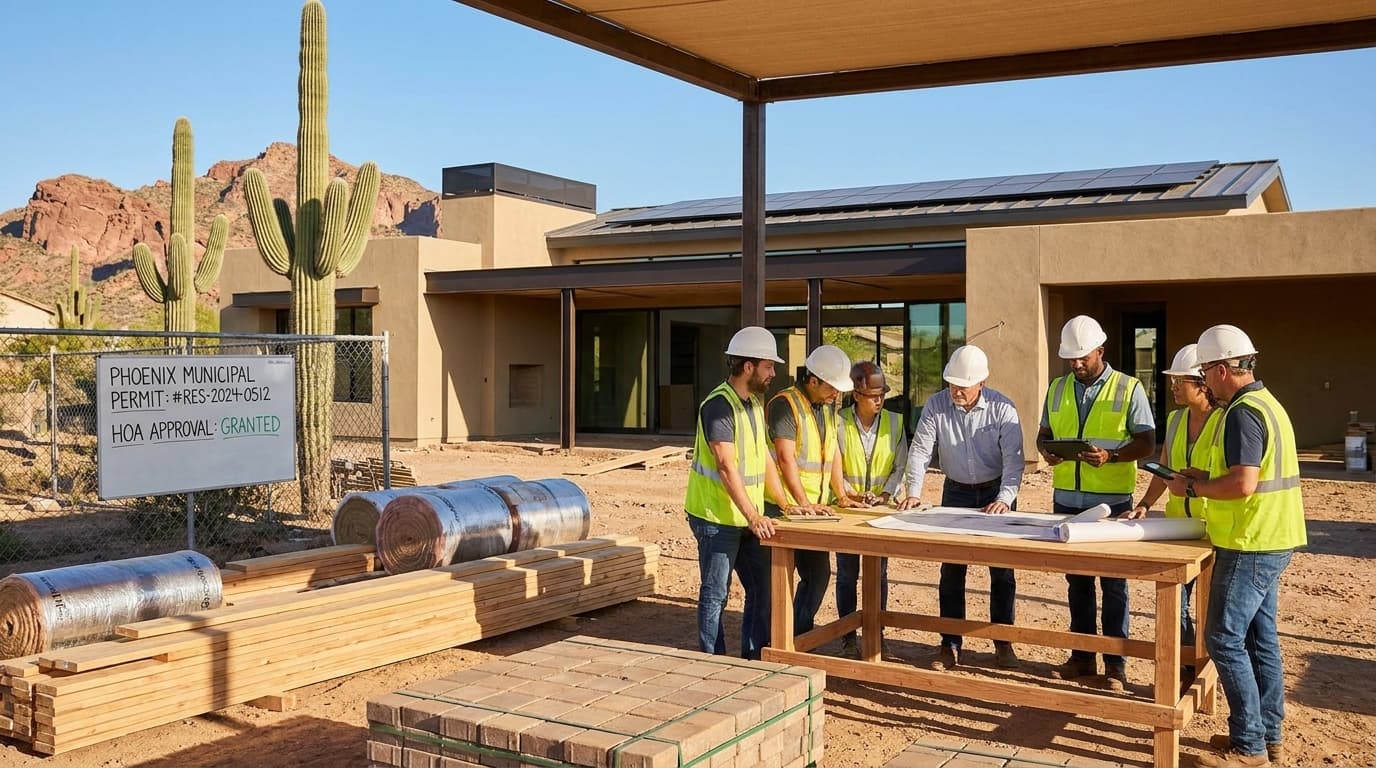
- Month 4: Streamlined Permitting and Construction Prep. Because the builder is already involved, we finalize construction documents and submit them to the City of Phoenix or surrounding municipalities, simultaneously ordering long-lead materials.
- Months 5+: Seamless Construction Execution. Groundbreak begins with zero communication gaps, as the folks who drew the plans are the same ones managing the site.
Phoenix-Specific Timeline Adjustments
Building in Arizona presents unique environmental and logistical challenges. The traditional model often stalls during the volatile summer monsoon season, where sudden storms disrupt separate bidding processes and disjointed material deliveries. By contrast, a unified team anticipates extreme heat schedules, secures early HOA approvals, and orders lumber and desert-specific materials well before the first shovel hits the dirt, effectively shielding your timeline from seasonal chaos.
Pros and Cons of Each Model for Phoenix Homeowners
No construction method is absolutely perfect for every single scenario. Weighing the design build vs general contractor Phoenix options requires looking at the raw benefits and drawbacks of both paths.
Traditional Contracting Pros:
- Allows you to gather competitive bids from multiple local general contractors.
- Creates a system of checks and balances where the architect acts in your interest to monitor the builder.
Traditional Contracting Cons:
- Extensive delays if contractor bids come back too high, forcing you to pay the architect for costly redesigns.
- High likelihood of change orders once construction begins, as builders discover plan discrepancies.
Design-Build Pros:
- Significant speed advantage due to concurrent design and construction prep.
- Unmatched budget control with continuous value engineering.
- Unified accountability, meaning you never have to mediate disputes between the designer and the builder.
Design-Build Cons:
- Slightly higher upfront design agreements before full construction costs are finalized.
- Less ability to shop around for the lowest possible construction bid once the design is underway.
If you are considering Phoenix home remodeling services, the unified accountability of design-build drastically reduces the stress of living through a major renovation.
2026 Phoenix Cost Guide: Design-Build vs. Traditional
In 2026, building costs in the Phoenix metro area have shifted due to inflation, specialized desert sourcing, and rising lumber rates. The way you contract your project directly impacts your bottom line. Traditional builds frequently lure homeowners in with lower initial construction bids, only to get hit with 10% to 20% overruns through unexpected change orders. Meanwhile, design-build projects may present a slightly higher initial number, but they are notorious for staying fixed, often coming in up to 10% under the anticipated final budget.
- Traditional Model Estimates: Expect roughly $150 to $250 per square foot, not including frequent architectural revision fees and inevitable mid-project change orders.
- Design-Build Estimates: Generally ranges from $175 to $275 per square foot, but this is a fixed, comprehensive number that bakes in accurate material costs and minimizes overages.
- Permitting Edge: Expedited, error-free permitting through a unified team can save homeowners between $2,000 and $5,000 in carrying costs and municipal revision fees.
Real Phoenix Project Cost Examples
To put this into perspective, consider a recent 2,000 square foot custom home project in North Phoenix. The homeowner initially explored the traditional route, but preliminary bids came back $60,000 over their limit. By shifting to a design-build model with Prolific Builders, the integrated team value-engineered the floor plan, sourced regional desert materials at a better rate, and ultimately saved the client 15% on their total build, delivering the home without a single budget increase.
Phoenix Regulations, Risks, and When to Choose Each
Building in Arizona means adhering to rigorous local regulations. Maricopa County enforces strict energy efficiency codes to combat the intense summer heat, and nearly every neighborhood operates under stringent HOA architectural review boards. The traditional model risks immense delays here, as bid shopping can drag on while HOA approvals expire.
The integrated model wins heavily for custom and complex builds, such as extensive additions or Phoenix custom homes that integrate new pool houses. A licensed, unified team navigates local zoning laws smoothly because they process these exact regulations together on a daily basis.
Decision Matrix
| Your Primary Needs | Recommended Model |
|---|---|
| You have a strict, immovable budget and hate financial surprises. | Design-Build |
| You want to personally manage multiple bids for the lowest raw price. | Traditional |
| You have a tight timeline and want to move in quickly. | Design-Build |
| You already purchased fully completed blueprints from an independent architect. | Traditional |
| You want complex structural changes, energy efficiency, and a unified warranty. | Design-Build |
Real Phoenix Case Studies: Prolific Builders’ Wins
The proof of the design build process Phoenix success is in the final product. Recently, a Scottsdale family came to us after a traditional process gone wrong. They had spent eight months and thousands of dollars on an independent architect, only to find out that local general contractors were quoting them 40% above their budget. By starting fresh with our unified approach, we redesigned their major kitchen and living space remodel, brought the materials into realistic alignment with their budget, and completed the project 30% faster than the previous contractors had estimated, all with zero change orders.
Another local client needed a high-performance desert custom home built within a strict 10-month window before relocating. Through concurrent design and early material ordering, our in-house team moved from initial concept to a fully dried-in structure right before the summer monsoons hit, proving that an integrated team is the ultimate safeguard against environmental delays.
Ready to Start Your Phoenix Project?
When you look closely at the data, the timelines, and the reduction in stress, the integrated approach is the clear winner for modern homeowners. Prolific Builders brings over 20 years of dedicated Arizona experience to the table, specializing in full-service custom builds that put the client first. Our comprehensive approach ensures that your vision is protected from the very first sketch to the final coat of paint.
Have questions about your specific lot, budget, or timeline? Give us a call today to schedule a comprehensive consultation with our in-house design and construction experts, and let us map out the perfect strategy for your new space.
Frequently Asked Questions
Is design-build more expensive in Phoenix?
Not necessarily. While the initial design agreement might feel like a distinct upfront cost, the total project cost is typically lower. By avoiding expensive architectural redesigns, preventing change orders, and buying materials early to beat inflation, design-build often saves homeowners between 5% and 15% overall compared to the traditional bidding process.
How long does the design build process take compared to traditional contracting?
Because the design and construction preparation phases overlap, an integrated project is typically completed 20% to 30% faster than a traditional build. You do not have to endure the lengthy waiting periods for separate contractor bids or municipal revisions caused by disconnected architectural plans.
Can I use my own architect for a design-build project?
Usually, the distinct advantage of this method is utilizing the firm’s in-house team to guarantee cohesive communication and budget alignment. However, some firms will collaborate with outside architects in a modified “team-build” approach, provided the builder is brought into the conversation at the very beginning of the design phase.
What happens if I want to make changes during construction?
Changes are much easier to handle in a unified model. Because the designer and builder are on the same team, they can immediately assess the structural and financial impact of your request, present you with a precise cost adjustment, and implement the change without cross-party disputes or massive delays.