Planning a custom home or major addition in Phoenix requires more than just a beautiful design. Before you pour the foundation, you must understand the invisible boundaries governing your land. Failing to identify building lot easements can lead to disastrous consequences, including forced demolitions or delayed city permits. Fortunately, getting your property’s setback requirements explained early in your project will ensure your new structure complies perfectly with local zoning laws. At Prolific Builders, we help homeowners navigate these complex property constraints to bring their custom luxury homes to life without the legal headaches.
What Are Building Lot Easements and Setback Requirements in Phoenix?
Every piece of real estate in Phoenix is subject to specific municipal and utility regulations that dictate exactly where you can and cannot build. While many homeowners use the terms interchangeably, easements and setbacks represent two entirely different legal restrictions on your property.
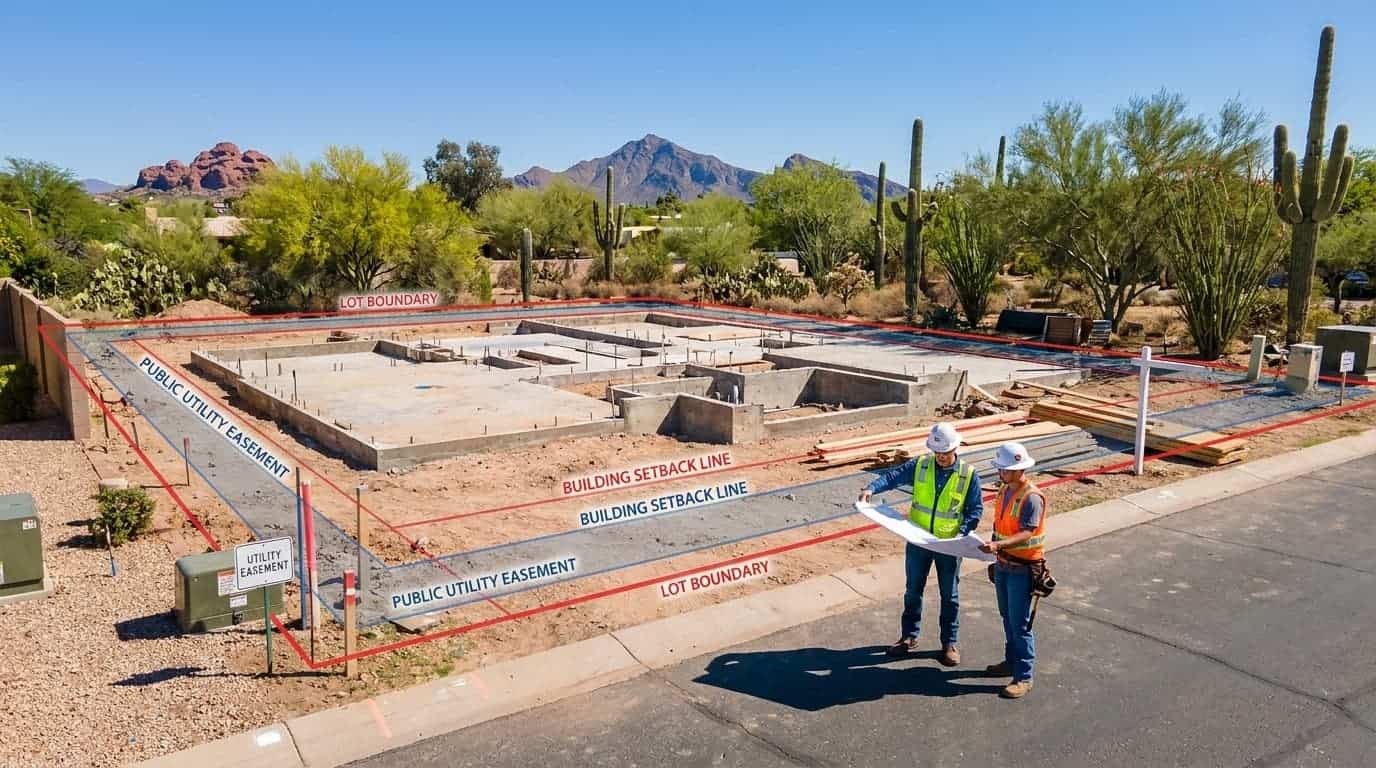
An easement is a legal right granted to a third party, such as the City of Phoenix or a local utility company, to use a specific portion of your land for a designated purpose. Even though you own the land, the easement holder has the right to access it for infrastructure maintenance, drainage, or public access. Setbacks, on the other hand, are strictly enforced zoning rules that mandate the minimum required distance between your property line and any permanent structure.
The Phoenix municipal code outlines very specific foundational rules that differ from general Arizona state regulations. Some of the most common basics you will encounter include:
- 8-foot Public Utility Easement (PUE): Typically required along the street frontage of your lot to accommodate water, sewer, and electrical lines.
- 6-foot Side Lot Utilities: Required on the sides of certain parcels for neighborhood infrastructure routing.
- 4-foot Alley Overhangs: Specific restrictions preventing roof eaves or balconies from encroaching into public alleyways.
Prolific Builders navigates these exact constraints for Phoenix clients daily, ensuring that your custom home design maximizes your usable lot space while remaining strictly compliant with municipal codes.
Common Types of Easements in Phoenix Lots and What You Can’t Build Over
Discovering an easement on your property does not necessarily mean your land is unusable. It simply dictates what types of improvements are legally permissible in that specific zone. Building permanent structures over certain easements is strictly prohibited by Phoenix city code, and violating these rules can result in the city tearing down your structure at your expense.
Here are the standard building lot easements in Phoenix and the restrictions associated with them:
- Utility Easements: These are reserved for power, water, and gas lines. You cannot build any permanent above-ground structures like garages or guest houses here. You are generally only allowed to install removable fences under 7 feet tall and basic flat paving.
- Drainage Easements: Usually requiring a minimum width of 10 feet, these zones ensure storm water flows safely away from homes during monsoon season. Blocking a drainage easement with a shed or retaining wall is a major code violation.
- Non-Access and Vehicular Easements: These restrict where vehicles can enter or exit a property, meaning you cannot pour a new driveway across a non-access line.
- Guy and Anchor Easements: Typically measuring 1 foot wide and 35 feet long, these are highly specific zones used to secure utility poles.
- Conservation and Light-Air Easements: Designed to preserve natural desert views or ensure adequate sunlight and ventilation between neighboring structures.
Per local regulations, no structures within a Public Utility Easement or major transmission easement can count toward your buildable lot area. Our team at Prolific Builders ensures complete compliance with these rules before groundbreaking, saving you from expensive redesigns.
Phoenix Setback Requirements Explained: Front, Side, Rear, and Special Rules
Having your setback requirements explained thoroughly is crucial for optimizing your yard space. While affluent areas like Paradise Valley might enforce massive 40-foot front and rear setbacks, the City of Phoenix has its own distinct set of zoning rules based on your specific neighborhood density and lot shape.
For standard residential lots, you must adhere to strict front, side, and rear boundary distances. However, Phoenix also features unique special rules for complex properties. For example, curvilinear easements on curved streets require a minimum 120-foot deflection angle to ensure safe visibility and utility access. Additionally, rear-adjacent lots often require a 110-foot minimum lot depth along with a 1-foot non-access buffer.
When it comes to accessory structures like detached garages, pool houses, or casitas, Phoenix allows a bit more flexibility. These secondary buildings typically only require a 3-foot setback from interior property lines, but they cannot occupy more than 30 percent of your total required rear yard area. There is also a standard frontage flexibility of plus or minus 20 percent for certain custom home builds, allowing for creative architectural placement. Prolific Builders optimizes builds within your setbacks, ensuring your home is positioned perfectly within legal limits.
The Dedication and Approval Process for Easements in Phoenix
If you are subdividing a lot, building a massive addition, or developing raw land, you may be required to dedicate a new easement to the city. The Phoenix easement dedication process is highly bureaucratic, but understanding the steps can prevent construction delays.
- Planning and Development Review: Your project begins with the Planning and Development department evaluating your site plan to determine if new public utilities or drainage routes are required.
- Application Submittal: You must submit a formal application, a detailed property questionnaire, and professional engineering drawings outlining the exact dimensions of the proposed dedication.
- Real Estate Title and Instrument Processing: The city’s real estate division will review your title report to ensure there are no conflicting liens or ownership disputes.
- Owner Sign-Off and Council Approval: Once the technical documents are verified, the property owner signs the dedication instrument, which is then sent to the Phoenix City Council for final legal approval.
- Release of Permits: Building permits and utility meters are strictly withheld until the City Council officially records the dedication.
If you hit a roadblock during this process, you can contact the city’s Real Estate Division directly at 602-262-7811. However, as an experienced local contractor, Prolific Builders handles all site planning submissions to fast-track your project and eliminate the stress of dealing with municipal paperwork.
How to Find and Verify Easements and Setbacks on Your Phoenix Property
Never assume your property lines end exactly where your fence sits. Fences are notoriously inaccurate in older Phoenix neighborhoods. To confidently verify your property’s legal constraints, you must do your due diligence.
- Check the Maricopa County Assessor’s Office: Start by looking up your parcel number on the county’s digital map to review basic boundary lines and recorded plat maps.
- Review Your Title Report: When you purchased your home, your title insurance policy included a section listing all recorded encumbrances, including public and private utility rights.
- Order a Professional Property Survey: This is the only guaranteed way to establish your exact buildable lines. A licensed surveyor will physically mark your lot corners and map out all invisible boundary restrictions.
- Hire a Surveyor for Encroachments: If you suspect a neighbor’s wall or an old shed is crossing the line, a professional survey provides the legal proof needed to resolve the dispute.
Prolific Builders reviews your plat maps and title reports during our initial consultation, ensuring we spot any red flags before the design phase begins.
2026 Cost Guide: Surveys, Permits, and Fixes for Easements and Setbacks in Phoenix
Budgeting for a new build means accounting for the administrative and legal costs associated with land compliance. Based on 2026 data for the Phoenix metropolitan area, here is what you can expect to pay for boundary verification and municipal permits.
A standard residential boundary survey typically runs between $1,500 and $3,000 depending on the complexity of your terrain and whether you have a curvilinear lot. If you need to officially dedicate land or apply for standard zoning approvals, permit fees generally range from $500 to $2,000.
The real expenses arise if you need to fix a violation or request an exception. Applying for a zoning variance to build slightly over a setback line can cost upward of $5,000 in administrative fees, legal representation, and architectural revisions, with no guarantee of approval. Lot size, existing encroachments, and the age of the neighborhood all heavily influence these final costs. Prolific Builders bundles survey coordination into our pre-construction services, securing cost savings and streamlined scheduling for our clients.
Easements vs. Setbacks Comparison Table + Troubleshooting Common Issues
To make the distinction crystal clear, we have broken down the primary differences and restrictions into a simple comparison format.
| Restriction Type | Typical Min Width / Distance | Allowed Builds | Common Violations |
|---|---|---|---|
| Public Utility Easement | 8 feet (Front/Street) | Fences under 7ft, flat paving, landscaping | Building a block wall or pouring a permanent foundation |
| Drainage Easement | 10 feet minimum | Open grass, permeable gravel | Installing retaining walls or sheds that block water flow |
| Front Yard Setback | 20 to 40 feet (Zoning dependent) | Driveways, mailboxes, low landscape walls | Extending a front porch or garage past the buildable line |
| Accessory Structure Setback | 3 feet from interior lines | Casitas, detached garages, pool houses | Placing a structure right on the shared neighbor boundary |
Even with careful planning, property issues can arise. If you discover a pre-existing encroachment, such as an old guest house built over a utility line by a previous owner, you may need to apply for a variance or negotiate a quiet title action. Landlocked access issues, where a neighbor must cross your property to reach the street, require clearly documented access agreements to prevent legal disputes. Prolific Builders resolves these complex zoning and compliance issues pre-build, ensuring your investment is fully protected.
Why Phoenix Homeowners Choose Prolific Builders for Compliant Builds
Building a custom luxury home or executing a major addition requires a partner who understands the intricacies of the Phoenix municipal code. Prolific Builders specializes in high-end, compliant construction tailored specifically to the unique zoning demands of Maricopa County.
Our comprehensive approach includes full permitting, professional site evaluations, and expert architectural planning. We do not just build beautiful structures, we build legally sound, optimized homes that maximize your lot’s potential while respecting all city-mandated setbacks and utility boundaries. Our deep Phoenix expertise means fewer delays, accurate budgeting, and total peace of mind from the drafting table to the final walkthrough.
Have questions about your property lines or ready to start planning your custom build? Give our team at Prolific Builders a call today to schedule your comprehensive site consultation.
Frequently Asked Questions
Can I build a fence over a utility easement in Phoenix?
Yes, in most cases, the City of Phoenix allows you to build a removable fence over a utility easement as long as it is under 7 feet tall and does not feature a deep, permanent continuous trench foundation that might damage underground pipes. However, utility companies reserve the right to remove sections of your fence if they need access, and they are not legally obligated to rebuild it.
What happens if I accidentally build over my setback line?
If you build over a required setback, you have committed a zoning violation. The city can issue a stop-work order, issue heavy fines, and ultimately force you to tear down the encroaching portion of the structure at your own expense. In rare cases, you can apply for a retroactive variance, but approval is notoriously difficult to obtain.
Do driveways count toward setback requirements?
Flat, poured driveways generally do not count as permanent building structures and are allowed within front and side setbacks. However, they cannot be placed in designated non-access or vehicular easements, and you must still adhere to maximum lot coverage limits set by your specific neighborhood zoning.
How long does the easement dedication process take in Phoenix?
Depending on the complexity of your project and the current backlog at the Planning and Development department, the dedication process can take anywhere from three to six months. This includes engineering reviews, title checks, and final City Council approval.