What Is a Construction Contingency Budget and Why Do You Need One?
When planning a new custom home or commercial project in the Valley, establishing a solid construction contingency budget is just as critical as selecting the right floor plan. A frequent question we hear from homeowners is exactly how much contingency for building is actually necessary to keep a project financially safe. In short, a contingency is a strategically calculated financial safety net reserved exclusively for unforeseen issues, site surprises, material cost fluctuations, or timeline delays. It is incredibly important to understand that a contingency budget is not a builder’s profit margin, nor is it a slush fund. It is an essential buffer that protects your investment.
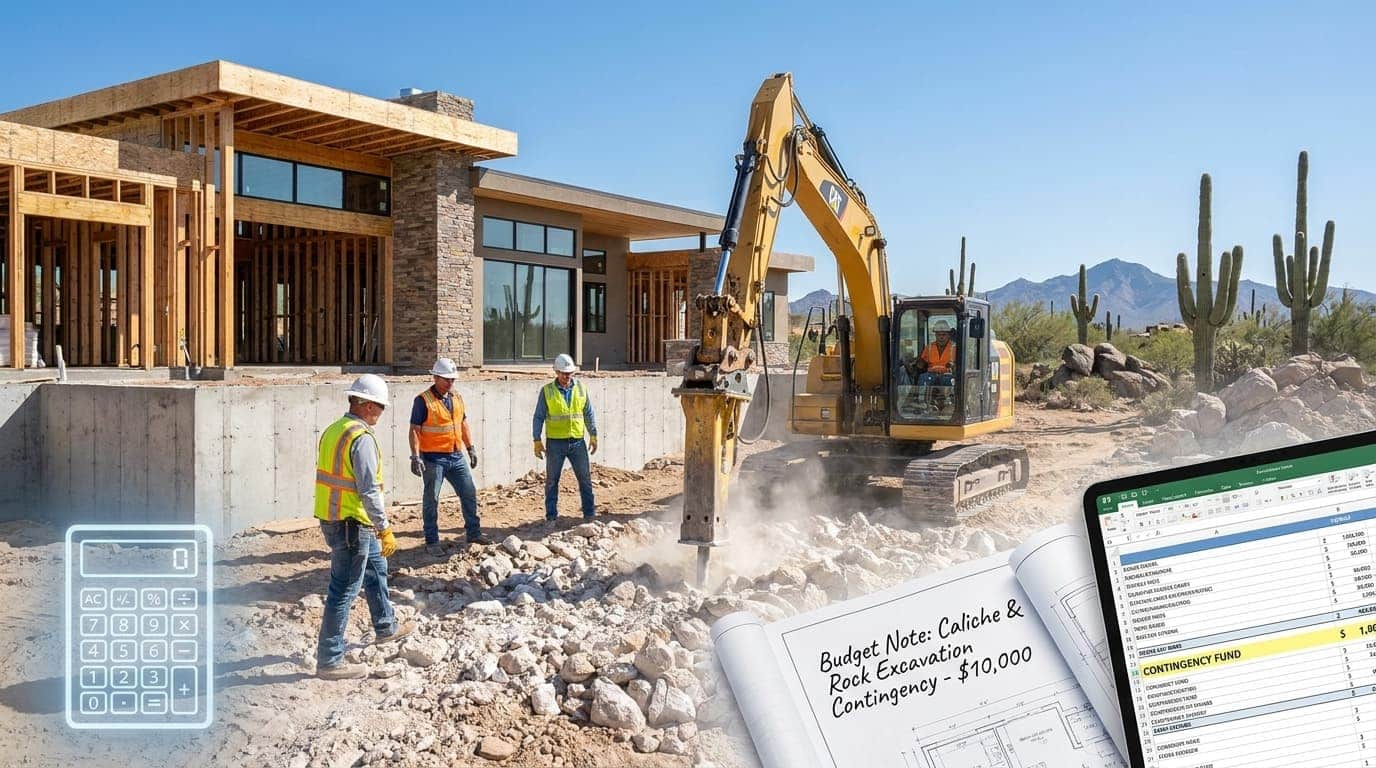
Building in the desert environment of Phoenix presents unique challenges that make this financial cushion non-negotiable. From striking hard caliche rock during excavation to heat-related labor delays in the peak of summer, unexpected costs are simply a reality of the construction process. While industry standards typically recommend holding anywhere from 5% to 20% of the total project cost in reserve, applying a generic percentage without understanding local variables can leave you exposed. At Prolific Builders, we believe in radical transparency. We integrate clear, realistic budgeting into every custom Phoenix home we build so that when surprises happen, your project doesn’t grind to a halt.
Standard Industry Benchmarks: How Much Contingency Is Typical?
Determining the exact construction contingency budget percentage requires analyzing the complexity, scale, and risk profile of your specific build. While traditional lenders generally require a bare minimum of 5% to 10% for low-risk, standard projects, that number rarely tells the whole story for custom residential builds. If you are constructing a standard, predictable residential home with well-defined plans and easy site access, a 5% to 10% reserve is typically sufficient. However, if your project involves highly innovative architectural designs, custom structural steel, or difficult terrain, you are firmly in the high-risk category, where a 10% to 20% cushion is highly recommended.
For custom homeowners wondering how much contingency for building is appropriate, the breakdown often depends on exactly what you are trying to achieve. High-end custom homes with intricate finishes and complex engineering generally fall into the 5% to 15% range. For mid-range custom homes in the Valley, Prolific Builders typically recommends a thoroughly risk-assessed 8% to 12% contingency buffer.
Here is a helpful breakdown of recommended contingency percentages based on project type:
| Project Type | Recommended % | Example for $500K Phoenix Build |
|---|---|---|
| Low-Risk New Build | 5-8% | $25K – $40K |
| Standard Residential | 5-10% | $25K – $50K |
| High-Risk / Commercial | 10-20% | $50K – $100K |
Phoenix AZ Factors: Why Your Contingency Needs Local Adjustments
General industry guidelines are helpful, but calculating your Phoenix AZ construction contingency requires a deep understanding of local environmental and regulatory factors. The desert is a beautiful place to build, but it can be notoriously unforgiving. For instance, digging a foundation in certain Phoenix suburbs can quickly turn into a costly endeavor if excavators hit caliche, a concrete-like soil layer that requires heavy machinery to break through. Furthermore, expansive clay soils in localized areas can dictate last-minute engineering changes to your foundation design.
Weather also plays a significant role. Summer monsoons can wash out recently graded sites, while extreme heat waves frequently necessitate altered labor schedules to protect the safety of the crew, which can extend the project timeline and increase equipment rental costs. Additionally, local permit delays via municipal planning departments or ADOT can stall progress. When considering how much contingency for building in Phoenix, you must also factor in 2026 inflation trends impacting regional supply chains. Material logistics for heavy items like adobe block, custom ironwork, or imported tiles often face unpredictable freight surcharges. Prolific Builders leverages years of local expertise to anticipate these exact desert-specific risks, helping to keep your budget highly insulated against local curveballs.
Phase-by-Phase Contingency Allocation for Smarter Budgeting
A common mistake homeowners make is treating their construction contingency budget as a single, lump-sum checking account that can be tapped into at any time. Smarter budgeting involves a construction contingency budget by phase. Risks are significantly higher at the beginning of a project when plans are transitioning from paper to reality. As the home comes out of the ground and the framing goes up, the potential for catastrophic surprises decreases.
For example, during the early design and permitting phase, you might allocate up to 15% of your contingency to absorb sudden municipal code changes or engineering adjustments. During active site work and foundation pouring, holding back 10% to 12% is wise due to the aforementioned soil surprises. By the time you reach the final construction and finishing phases, a much smaller 5% allocation is typically all that is needed to handle minor delays or minor material swaps. At Prolific Builders, our phased approach means that as we successfully clear high-risk milestones, we can return unused contingency funds to the client, or redirect them toward luxury finish upgrades.
| Phase | % Allocation Focus | Phoenix Example Risks |
|---|---|---|
| Design / Permitting | 15% | Sudden local code changes or HOA design rejections. |
| Site Work / Excavation | 10-12% | Hidden caliche rock or expansive soil surprises. |
| Active Construction | 5% | Extreme summer heat delays or material backorders. |
2026 Phoenix Cost Guide: Real Numbers for Your Build
Understanding how much contingency for building Phoenix 2026 requires looking at real-time market data. The construction landscape continues to evolve, and budgeting based on outdated figures from even two years ago is a recipe for financial stress. For a standard $500,000 custom home build in the current Phoenix market, you should anticipate needing a cushion of $40,000 to $75,000. This accounts for ongoing inflationary pressures, such as an anticipated 5% variance in lumber pricing due to shifting North American supply chains, as well as fluctuating copper and concrete costs.
To calculate your baseline needs, use a simple formula: Total Estimated Hard Costs x Your Risk Percentage. If your site is on a steep hillside in North Scottsdale or involves a complex teardown in Arcadia, you must multiply your hard costs by the higher end of the risk spectrum. We highly encourage homeowners to pursue a thorough financial review before breaking ground. To support our community, Prolific Builders offers a free contingency audit alongside our detailed Phoenix construction estimates to ensure your math aligns with 2026 reality.
Contractor vs. Owner Contingency: Key Differences and Best Practices
One aspect of financial planning that frequently causes confusion is the distinction between contractor-funded and owner-funded contingencies. A contractor contingency is typically built directly into the builder’s bid, generally ranging from 2% to 10%, and is managed by the builder to cover minor estimating errors, small material shortages, or subcontractor adjustments. This protects the builder’s ability to deliver the project as promised without constantly returning to the client for pennies.
Conversely, an owner contingency budget is held separately by you, the client. This fund is entirely within your control and is used for owner-driven change orders, such as deciding midway through the build that you want premium quartz countertops instead of standard granite, or upgrading your HVAC system for better desert cooling. Keeping this fund separate from the contractor’s working capital is a best practice that ensures cleaner accounting and prevents your reserve from being absorbed into general construction costs. Prolific Builders excels at providing completely transparent, owner-funded contingency structures. We document every draw meticulously and utilize modern tracking software so you always know exactly where your reserve funds stand.
Common Mistakes and How to Avoid Them in Phoenix Builds
When analyzing construction contingency budget mistakes Phoenix homeowners make, three major pitfalls consistently rise to the top:
- Underestimating the Risk: Setting a contingency below 5% is incredibly dangerous. In the Phoenix market, a single foundational issue involving hidden water tables or thick layers of caliche clay can easily wipe out a 3% reserve, forcing the project to halt while you secure additional financing.
- Treating the Contingency as “Optional”: Some property owners view the contingency as a luxury rather than a necessity. Lenders know better, and so should you. Assuming everything will go exactly according to plan in custom construction is the fastest route to budget failure.
- Poor Expense Tracking: Failing to monitor how and when contingency funds are utilized can leave you depleted before you even reach the drywall phase. Without clear documentation, it is easy to accidentally spend contingency money on upgrades when it should be saved for structural necessities.
To mitigate these issues, thorough planning is essential. The rigorous risk audits performed by Prolific Builders are specifically designed to highlight potential pitfalls long before the first shovel hits the dirt, ensuring your budget remains resilient from day one.
Ready to Build in Phoenix? Get Your Custom Contingency Plan
Setting the right financial foundation is the most critical step in realizing your dream home. Remember the golden rule of custom construction: rely on a 5% to 20% contingency base, but actively tweak that number to account for Phoenix’s unique soil, weather, and current market trends. A well-planned reserve doesn’t just protect your wallet; it protects your peace of mind throughout the entire building process.
If you are preparing to break ground and want to ensure your financial planning is airtight, we are here to help. Have questions? Give us a call or reach out to Prolific Builders to schedule your free quote and discuss a Phoenix-specific budgeting strategy tailored directly to your project.
Frequently Asked Questions
What happens if I don’t use all of my construction contingency budget?
If your project goes smoothly and you do not utilize the full contingency amount, those funds remain yours. Most homeowners choose to either pocket the savings, return it to their construction loan principal to lower their mortgage, or reinvest the money into late-stage luxury upgrades like premium landscaping or high-end appliances.
Do construction loans cover the contingency budget?
Yes, most reputable lenders require a contingency budget to be built into the total construction loan amount. Typically, lenders mandate a minimum of 5% to 10% to ensure the project can be completed even if unexpected costs arise. These funds are held in reserve and are only released by the bank through a formal draw process when justified by unexpected expenses.
Can I use my contingency budget for design upgrades?
Your owner-funded contingency can be used for change orders, such as upgrading materials or altering finishes. However, it is highly recommended that you do not touch your contingency for optional upgrades until the most high-risk phases of construction (like site prep, foundation, and framing) are fully completed and paid for.
How do summer temperatures in Phoenix impact my budget?
Extreme summer heat in Phoenix often requires construction crews to start earlier in the day or work shorter shifts to prevent heat exhaustion. This can sometimes extend the overall project timeline, leading to higher costs for equipment rentals (like scaffolding or portable toilets) and increased project management fees, making a robust contingency essential.