
7 Signs You’re Hiring the Wrong Custom Home Builder in Phoenix
The Phoenix custom home market has enough horror stories that the warning signs are worth knowing before you sign anything. Custom home builders in Phoenix vary significantly in accountability, transparency, and craft, and the ones most likely to cause problems rarely announce it in their sales process. The red flags come out in the details of how a builder communicates, prices, and structures accountability, not in their marketing language.
If you ignore these seven signs, the consequences run from cost overruns and missed deadlines to half-finished homes and contractors who stop returning calls entirely.
Quick Answer: The seven biggest warning signs when hiring a Phoenix custom home builder are: no line-item estimate before signing, design and construction on separate contracts, vague warranty language, no ROC license verification, lump-sum pricing with no breakdown, inability to name the project manager who will run your job, and no written change-order policy. Prolific Builders eliminates all seven risks by design. Arizona ROC License #356246. BuildZoom Score 100. Call (480) 972-3000 for a free consultation.
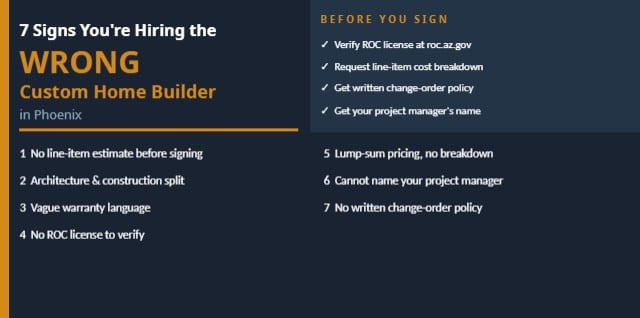
What Happens When You Hire the Wrong Builder in Phoenix
Building a custom home that goes wrong in Phoenix does not just cost money. It costs time, relationship equity with your spouse or partner, and in the worst cases, real legal exposure. Partially completed construction has been abandoned by contractors who took deposits and disappeared. Homes built with unpermitted work have been condemned or required to be torn down. Designs built without engineering sign-off have failed inspection and required structural corrections after the walls were in place.
These are not outliers. They are the documented outcomes of specific, avoidable mistakes made before the contract was signed. Every one of the seven signs below is a documented precursor to a bad outcome.
Sign 1: They Cannot Give You a Line-Item Estimate Before Signing
What it looks like: The builder presents a per-square-foot number, a total project estimate as a single dollar figure, or says “we’ll break it down once we get into design.” They ask you to sign a design agreement or a letter of intent before showing you a detailed cost breakdown.
Why it matters: A builder who cannot give you a line-item estimate before signing is either concealing how they allocate costs or has not yet done the work to know what your project actually costs. Both are problems. The line-item estimate is the only document that lets you verify whether the number in your contract reflects reality. Without it, you have no leverage when a change order adds $50,000 to a project you thought was fixed.
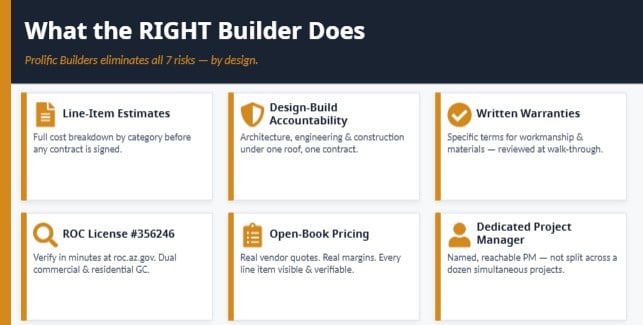
What the right builder does: Prolific Builders delivers a line-item estimate broken down by category: site work, foundation, framing, MEP systems, insulation, windows, finishes, permits and fees, and builder overhead and margin, all as separate line items, before any contract is signed.
Sign 2: Architecture and Construction Are on Separate Contracts
What it looks like: The builder recommends hiring an architect separately. You pay the architect directly and receive a set of drawings. The builder then bids on those drawings. The two parties have no formal coordination agreement and no shared accountability for whether the design can be built within your budget.
Why it matters: “Ballooning budgets, missed deadlines, and contractors who stop answering the phone” is the precise failure sequence that results when architecture and construction are split. When the permit drawings come in 25% over budget, the architect says the contractor’s prices are too high. The contractor says the design is too expensive to build as drawn. You are in the middle, with paid architectural drawings and no path forward that doesn’t cost you more money.
What the right builder does: The design-build model at Prolific Builders puts architecture, engineering, and construction under one contract. One team. One accountability. Zero hand-offs.
Sign 3: Their Warranty Language Is Vague
What it looks like: “We stand behind our work.” “We guarantee customer satisfaction.” “Quality is our priority.” None of these is a warranty. A real warranty names a duration, covers specific categories of work (labor separately from materials), defines what is covered and what is excluded, and specifies the claims process.
Why it matters: Warranty language is not boilerplate. It is the document you will need if the HVAC system installed in your new Phoenix home fails before the manufacturer’s equipment warranty covers it, or if a tile installation fails to waterproof six months after move-in. A builder who uses vague warranty language is either not thinking about what happens after you move in or actively protecting themselves from obligation.
What the right builder does: Written workmanship and material warranties on every project, with specific terms reviewed during the Completion and Walk-Through before keys change hands.
Sign 4: They Cannot Give You an ROC License Number You Can Verify
What it looks like: The builder says they are licensed, but cannot provide an ROC license number upon request. Or they provide a business license number instead of an ROC contractor license number. Or the ROC license is expired, suspended, or carries unresolved complaints in the Arizona Registrar of Contractors database.
Why it matters: Working with an unlicensed contractor in Arizona means no permit protection, no recourse through the ROC complaint process, and no verified proof of competency. The Arizona Registrar of Contractors requires licensed contractors to pass a classification-specific examination and maintain insurance and bonding. An unlicensed builder has none of these protections in place for your project.
What the right builder does: Prolific Builders holds Arizona ROC License #356246 as a dual commercial and residential General Contractor. Verify it at roc.az.gov in under two minutes. The BuildZoom Score of 100 is the secondary confirmation: it reflects a verified permit history and clean license record across every completed project.
Sign 5: They Present One Number with No Breakdown
What it looks like: The proposal shows a single total project cost or a per-square-foot number with no category breakdown. When you ask what is included, the answer is “everything.” When you ask what is excluded, the answer is “nothing.”
Why it matters: “Cost much higher than what was estimated” is the most common complaint in Phoenix contractor reviews, and it almost always traces back to a lump-sum estimate with an insufficiently defined scope. The word “everything” in a verbal conversation means nothing in a written contract. When the countertops you imagined turn out to be a $10,000 upgrade from the “allowance” included in the estimate, you are paying a change order you did not anticipate because the original estimate never defined what “everything” included.
What the right builder does: Open-book budgeting. Real vendor quotes. Real builder margins. Every line item is visible and verifiable before the contract is signed.
Sign 6: They Cannot Name the Person Who Will Run Your Project
What it looks like: The salesperson or owner presents the project to you. When you ask who will be your day-to-day project manager, the answer is vague: “our team,” “an experienced PM,” “we’ll assign someone.” No name. No profile. No chance to have a direct conversation before you sign.
Why it matters: “Left in the dark” and “contractors you can’t reach and who don’t do what they say they are going to do” are the words Phoenix custom home buyers use to describe the experience of not having a dedicated, named point of contact. In high-volume builder operations, PMs are stretched across multiple simultaneous projects. Your project is one of a dozen. When a question comes up mid-construction that requires a real decision, you are waiting days for a callback from someone who has to check a spreadsheet to remember what stage your house is in.
What the right builder does: Prolific Builders is boutique by choice. They do not take on more than can be done right. Your dedicated project manager is named, reachable, and not managing eleven other projects simultaneously. The weekly update format keeps you informed without requiring you to chase down information.
Sign 7: They Have No Written Change-Order Policy
What it looks like: When you ask how changes are handled after the contract is signed, the answer is “we’ll figure it out as we go,” “just let us know what you want,” or “changes are no problem.” Nothing is in writing. No process is described for documenting, pricing, approving, and executing changes.
Why it matters: “Substitutions without your sign-off” is a documented complaint in Phoenix remodel and custom build reviews. It happens when a contractor makes a material substitution because the specified item has a long lead time and communicates this after the fact as “we had to use X instead of Y.” Or when a scope change occurs verbally on site and appears on an invoice at the end of the project. A written change-order policy is the only protection against both.
What the right builder does: Every change order at Prolific Builders is documented in writing with updated pricing and timeline impact before work proceeds. You approve in writing before anything changes. No exceptions.
[DEVELOPER: Style as a visually distinct pull quote.]“Our home now feels modern and beautiful.”
– Adam Jones, Realtor | Phoenix, AZ ⭐⭐⭐⭐⭐ via Google Reviews
What to Do Before Signing with Any Phoenix Custom Home Builder
Before signing any custom home contract in Phoenix, do four things.
First: Get the ROC license number and verify it at roc.az.gov. Confirm it is current, check the classification, and look for any unresolved complaints or disciplinary history.
Second: Request a line-item estimate broken down by construction category. If the builder refuses or says the breakdown comes later, walk away.
Third: Ask for the written change-order policy in writing before signing. Read it. If there is no written change-order policy, the verbal reassurances mean nothing when a dispute arises six months into construction.
Fourth: Ask who your dedicated project manager will be and how you will communicate with them throughout the project. Get a name and a direct contact method before signing.
The builders who pass all four checks without hesitation are the builders worth signing with.
Get My Free Phoenix Build Consultation
Arizona ROC #356246. BuildZoom Score 100. No-obligation estimate.
Call (480) 972-3000 | prolificbuilders.com
Frequently Asked Questions: Hiring the Right Custom Home Builder in Phoenix
How do I check a Phoenix contractor’s license before hiring them?
Visit roc.az.gov and search by contractor name or license number. The Arizona Registrar of Contractors database shows current license status, license classification, expiration date, and complaint or disciplinary history. Always verify before signing any contract for a project of this size. Prolific Builders holds ROC License #356246 as a dual commercial and residential General Contractor.
What is an “allowance” in a custom home estimate, and why is it risky?
An allowance is a placeholder dollar amount in an estimate for a category where the exact selections have not yet been made, such as flooring, countertops, or plumbing fixtures. The risk is that allowances are often set based on builder preference rather than buyer expectation. If you imagine quartz countertops and the allowance is based on laminate pricing, the difference comes out of your pocket as a change order when you select the product you actually want.
What is the ROC complaint process if a Phoenix contractor does not perform?
File a complaint at roc.az.gov. The Arizona Registrar of Contractors investigates complaints against licensed contractors and can order correction of defective work, assess penalties, and suspend or revoke licenses for serious violations. This process is only available against licensed contractors. Working with an unlicensed contractor removes this avenue of recourse entirely.
Should I get multiple bids for a custom home build in Phoenix?
Getting two to three bids is reasonable for comparing pricing and approach. Be cautious of bids that are significantly lower than others: the gap usually reflects either an incomplete scope or unrealistic assumptions that will surface as change orders. The most important thing when comparing bids is to confirm each one covers the same scope and is broken down in enough detail to compare apples to apples.
What are the most common complaints against Phoenix custom home builders?
Based on publicly available ROC complaint data and consumer review patterns, the most common complaints involve: work not completed as contracted, cost overruns beyond the original estimate, abandoned projects, unlicensed subcontractors working on permitted jobs, and failure to obtain required permits. All five of these outcomes are preventable with proper due diligence before signing.
How does open-book pricing protect me from cost overruns?
Open-book pricing shows you the actual vendor quotes behind every line item in your estimate and the builder’s margin as a transparent number. You can verify any line item independently if you choose. This eliminates the scenario where a builder pads costs and pockets the margin on a lump-sum contract. It also makes change orders honest: if a subcontractor’s price changes, you see the actual invoice, not a builder-determined markup.
What does “boutique by choice” mean in a custom home building context?
It means the builder intentionally limits the number of projects they take on simultaneously to maintain quality and attention to detail on each one. The alternative is a high-volume model where PMs manage many projects at once, and individual attention per project decreases as volume increases. Prolific Builders’ boutique capacity model means your project gets real attention from a dedicated team rather than being one of many.
Is a 5.0-star Google rating a reliable indicator of a good custom home builder?
A perfect rating is a positive signal, but review volume matters. A 5.0 rating on 4 reviews is less meaningful than a 4.8 on 200 reviews. Also, check how reviews were earned: builders who run aggressive review campaigns can accumulate ratings quickly without the volume of organic referral reviews that reflect actual long-term client satisfaction. Prolific Builders holds a 5.0 rating on 15+ reviews, all earned through word-of-mouth referrals before any online marketing existed.
What happens if my Phoenix builder abandons the project mid-construction?
Contact the Arizona Registrar of Contractors immediately and file a complaint. The ROC has the authority to investigate and order remediation. Check whether the contractor’s bond is current: a licensed and bonded contractor provides a financial recovery mechanism that unlicensed contractors do not. For a project of significant scope, consulting a construction attorney in parallel with the ROC complaint is advisable. This is the exact situation the ROC licensing requirement is designed to protect against.
How do I get started with Prolific Builders to avoid these problems?
Call (480) 972-3000 or submit the contact form at prolificbuilders.com. All Phoenix-area inquiries receive a response within one business day. The first conversation covers your goals and budget range, with no obligation. Prolific Builders provides line-item estimates, written change-order policies, dedicated project managers, and ROC License #356246 verification before you sign anything. BuildZoom Score 100. No-obligation estimate.
About the Author
Victor Torres, Owner and General Contractor at Prolific Builders, has spent over a decade in Arizona custom construction and has seen firsthand what separates builders who deliver from those who do not. He holds an Arizona ROC License #356246 as a dual commercial and residential General Contractor and has earned a BuildZoom Score of 100. Read Victor’s full bio.