How Does Custom Home Building Work in Phoenix, AZ?
How custom home building works in Phoenix is more straightforward than most buyers expect, once you have a builder who explains each stage before it happens rather than after. The process runs from initial contact through the final walk-through in five defined stages, with specific decisions required at each gate before work can advance.
Quick Answer: Phoenix custom home building follows five stages: initial contact, Vision Meeting, Concept and Estimate, Design-Build Agreement, and Completion and Walk-Through. The process runs 14 to 28 months from first contact to key handover, depending on complexity and permitting timelines. Prolific Builders manages the entire sequence under a single contract, with weekly updates and no scope changes made without written approval. Arizona ROC License #356246. BuildZoom Score 100. Call (480) 972-3000 for a free consultation.
Why the Phoenix Custom Home Building Process Is Different from Other Markets
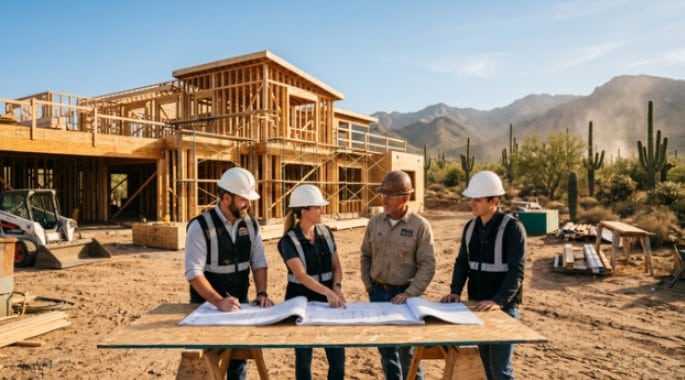
Building a custom home in the Valley of the Sun involves decisions and requirements that do not apply in moderate climates. Soil conditions in the Phoenix desert often include expansive clay or caliche hardpan that requires engineered foundations. Permitting in multiple jurisdictions (City of Phoenix, Scottsdale, Paradise Valley, Maricopa County) follows different timelines and inspection sequences. Material specifications that are standard nationally underperform in 115-degree summers. A builder who knows these specifics from experience makes different recommendations than one applying generic national standards to a desert site.
Stage 1: Initial Contact and Qualification (Week 1)
What happens: You submit the contact form at prolificbuilders.com or call (480) 972-3000. Prolific responds within one business day. The first conversation covers your goals, lot situation, budget range, and preliminary timeline. This call takes 20 to 30 minutes and is obligation-free.
What you decide: Whether the project is a fit for Prolific’s scope and capacity. Projects outside the Phoenix Valley service area, below the minimum project value threshold, or requiring services Prolific does not offer (standalone landscaping, pool-only builds, handyman work) are declined at this stage rather than later, which protects your time.
What Prolific determines: Whether your budget, timeline, and site situation are realistic for the type of home you want. If there is a significant mismatch, they say so at this stage rather than after you have spent money on design.
Tips for Phoenix homeowners: Have a realistic budget range, not just a dream number. Know whether you own land or are still searching. If you have inspiration images or a rough idea of square footage, bring them. The more specific you can be in this conversation, the more accurate the subsequent estimate will be.
Stage 2: Vision Meeting (Weeks 2 to 4)
What happens: An in-person or virtual meeting with the Prolific Builders team. You share your vision, priorities, non-negotiables, and investment range. Bring inspiration photos, sketches, notes about must-have features, and any architectural ideas you have developed. This conversation maps lifestyle needs: office space, guest suite, outdoor kitchen, multi-car garage, accessibility requirements, or anything else that defines how the home will function for your family.
What you decide: The general program for the home: rough square footage, number of bedrooms and bathrooms, primary indoor/outdoor living priorities, and the style direction (modern desert contemporary, Mediterranean estate, ranch, or other). You also confirm whether your budget aligns with the scope before any design dollars are spent.
What Prolific determines: Site feasibility for the type of build you want. If you own land, this is when a preliminary lot evaluation happens: soil conditions, utility access, setback requirements, and HOA constraints. If you do not own land yet, this is when the team can advise on what to look for and what to avoid.
Tips for Phoenix homeowners: Be honest about your budget ceiling. Builders who say “we can make any budget work” are the ones who make it work on paper, not in practice. Prolific will tell you directly what your budget can produce in the Phoenix market, rather than designing a home you cannot afford to build.
Stage 3: Concept and Estimate (Weeks 4 to 12)
What happens: The Prolific design team translates your Vision Meeting discussion into preliminary floor plans, elevations, and 3D renderings. Simultaneously, the construction team prices the design against current Phoenix market conditions. You receive a line-item cost estimate broken down by category: site work, foundation, framing, roofing, mechanical and electrical systems, insulation, windows, exterior finishes, interior finishes, cabinetry and countertops, permits and fees.
This is the stage at which the design-build model delivers its greatest benefit. Because the architect and contractor are on the same team, cost feasibility is checked against real current vendor quotes at the sketch stage. A traditional model checks the cost after the permit set is complete. At that point, you are already invested in drawings that may be 20% over budget, and you either pay the overage or start over.
What you decide: Whether the preliminary design and pricing align with your goals. This is the stage where you can modify layouts, adjust square footage, change finish specifications, or revisit site features to bring the number into range. No money is committed to construction at this stage.
The open-book pricing model in practice: Prolific shows you real vendor quotes and builder margins as line items. If you want to know why the framing allowance is $X, you can see the lumber quote and the labor breakdown behind it. This level of transparency is not standard in the Phoenix market. Most builders present a lump sum or a per-square-foot number with no visibility into composition.
Tips for Phoenix homeowners: Ask questions. The Concept and Estimate stage is where it is cheapest to change your mind. A floor plan modification at this stage costs a few hours of design time. The same modification, after the foundation is poured, costs tens of thousands of dollars and weeks of schedule time.
Stage 4: Design-Build Agreement (Weeks 12 to 20)
What happens: Once the design and pricing align with your goals, Prolific prepares the construction documents required for permit submission. This includes architectural drawings, structural engineering, energy compliance calculations, and all jurisdiction-specific requirements for Phoenix, Scottsdale, Paradise Valley, or wherever your lot is located.
The building permit application is submitted to the appropriate jurisdiction. Phoenix permit processing typically runs 4 to 8 weeks for a complete residential plan set. Scottsdale and Paradise Valley can run longer for projects in HOA-governed areas or on lots with specific design review requirements.
Simultaneously, the Design-Build Agreement is executed. This contract locks in the timeline, payment schedule, building standards, material specifications, and change-order procedure. The payment schedule is tied to construction milestones, not calendar dates, so payments reflect actual progress.
What you decide: Final material selections for all major categories before construction begins. Flooring, cabinetry style and species, countertop material, exterior finishes, roof material, plumbing fixtures, lighting fixtures, and appliances. Making these selections before the framing inspection is complete prevents the situation where you are choosing tile in a contractor’s showroom under a three-day deadline because the tile setter is starting next week.
Change orders during construction: Every change order is documented, including updated pricing and timeline impact, before work proceeds. You approve in writing before anything changes. This is the protection that prevents the “I thought that was included” conversation from happening.
Tips for Phoenix homeowners: Do not rush the material selection phase. Every selection finalized before groundbreaking is a decision you cannot regret because time pressure forced you to make it. The design-build agreement stage is built to absorb this work before the clock runs out.
Stage 5: Construction Through Completion (Months 4 to 24)
What happens: Construction proceeds in a defined sequence. Site preparation, grading, and underground utilities first. Foundation: typically post-tension slab on grade in Phoenix with engineered design for local soil conditions. Framing, sheathing, and roof structure. Rough-in for mechanical, electrical, and plumbing. Insulation. Drywall. Cabinetry, countertops, tile, flooring, fixtures, and finish hardware. Exterior finish: stucco system, paint, and any stone veneer. Landscaping coordination (Prolific coordinates grading and utility placement; standalone landscaping is managed separately). Final inspections and certificate of occupancy.
Throughout construction, a dedicated project manager coordinates all trades and provides weekly check-in updates. Every trade partner signs a workmanship checklist and uploads documentation at each phase. You are never left asking what was completed last week or what is starting next week.
What the Phoenix climate means for construction timing: Foundation and framing typically happen in fall through spring in the Valley. Running framing through a Phoenix July is a crew endurance exercise that slows productivity. Prolific schedules projects to take advantage of the favorable fall and winter months for exterior rough-in, wherever the timeline allows. This is a detail that builders without deep Valley experience often ignore.
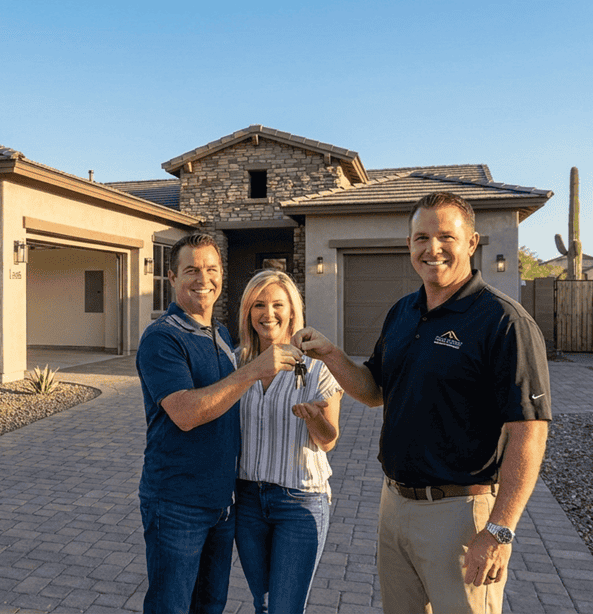
The Completion and Walk-Through: After final inspections pass, a comprehensive walk-through covers every system in the home: HVAC operation, plumbing, electrical, smart-home systems, appliances, and exterior drainage. You receive documentation packages for every system, appliance, and material. Warranty coverage is reviewed, and written terms are confirmed. Keys change hands only after you are satisfied. Prolific Builders backs all work with written workmanship and material warranties, and they remain reachable after you move in.
[DEVELOPER: Style as a visually distinct pull quote.]“Experience was fantastic from start to finish. Communication was clear, the work was high quality.”
– Adam Jones, Realtor | Phoenix, AZ ⭐⭐⭐⭐⭐ via Google Reviews
How Long Does Each Stage Take?
| Stage | Typical Duration | Key Variable |
|---|---|---|
| Initial Contact | 1 week | Response time and fit assessment |
| Vision Meeting | 1 to 3 weeks | Scheduling and preparation |
| Concept and Estimate | 4 to 8 weeks | Design complexity and iteration rounds |
| Design-Build Agreement and Permitting | 8 to 16 weeks | Jurisdiction and design review complexity |
| Construction | 10 to 18 months | Home size, complexity, and material lead times |
| Total: First Contact to Keys | 14 to 28 months | All of the above |
Prolific reports 92% of projects finishing within two weeks of the promised completion date, based on proactive scheduling and weekly trade-partner checkpoints. The single most common cause of delays in Phoenix custom builds is material lead times on custom items: custom windows, specialty stone, and custom cabinetry with 12 to 20-week lead times. These are ordered during the Design-Build Agreement stage, before construction begins, which is why the selection phase matters so much.
What Arizona ROC License #356246 Means for You
Prolific Builders holds Arizona ROC License #356246 as a dual commercial and residential General Contractor. Verify it at roc.az.gov in under two minutes. A dual commercial and residential classification reflects a more comprehensive licensing examination than a residential-only license. Along with a BuildZoom Score of 100, the verified permit history for every completed Prolific project is publicly accessible to any prospective buyer.
The license matters for practical reasons during construction. Every permit is pulled under Prolific’s license. Every inspection is scheduled and passed under their accountability. Every subcontractor working on your project is managed by a licensed General Contractor who is responsible for the quality and code compliance of that work. When something is not right, there is no subcontractor to blame. There is one contractor accountable for the outcome.
Most Phoenix custom-home buyers do not know what stage they are in until a builder tells them. The Concept and Estimate stage is where most confusion lives: how much does this actually cost, and how long will it actually take?
Prolific Builders answers both questions with real numbers before you sign anything.
Call Prolific Builders: (480) 972-3000 or visit prolificbuilders.com
Arizona ROC #356246. BuildZoom Score 100. No-obligation estimate.
Frequently Asked Questions: How Custom Home Building Works in Phoenix
How long does it take to build a custom home in Phoenix?
14 to 28 months from first contact to keys, depending on home size, complexity, and jurisdiction permitting timelines. Construction alone runs 10 to 18 months after permits are issued. Prolific Builders reports that 92% of projects finish within two weeks of the promised completion date, thanks to proactive scheduling and weekly trade-partner checkpoints.
What is the difference between custom and semi-custom home building?
A custom home is designed from scratch for a specific lot and a specific owner’s lifestyle. Layouts, room sizes, finishes, and systems are determined by the owner’s preferences, not a developer’s floor plan template. A semi-custom home starts from an existing floor plan that can be modified in limited ways. Custom builds cost more and take longer because every decision is made from scratch, but the result is a home that fits your life exactly, not just approximately.
Do I need an architect before hiring a custom home builder in Phoenix?
Not if you hire a full design-build firm. Prolific Builders includes architectural design, structural engineering, and interior design coordination within the design-build scope. You do not need to hire a separate architect, pay for drawings separately, and then coordinate between two firms. If you already have architectural plans, Prolific can review them for buildability, code compliance, and cost feasibility as part of the initial engagement.
What soil conditions in Phoenix affect foundation design?
Two conditions are common in the Phoenix Valley. Expansive clay soils swell significantly when saturated and shrink during drought cycles, which causes foundation movement in homes with inadequate engineered preparation. Caliche, a calcium carbonate hardpan layer found in many Valley lots, requires specialized excavation equipment and can significantly increase site-preparation costs. Prolific’s lot evaluation identifies both conditions before purchase when possible, and the foundation design accounts for local soil conditions through a structural engineer’s specification.
What permits does a custom home in Phoenix require?
A complete custom home build in Phoenix requires, at a minimum, a building permit, a grading and drainage permit, an electrical permit, a mechanical (HVAC) permit, and a plumbing permit. Projects in HOA-governed communities require design review approval before permit applications are submitted. Paradise Valley and Scottsdale have additional architectural review requirements. Prolific Builders handles all permit applications as part of the design-build agreement.
What is a post-tension slab, and why is it used in Phoenix?
A post-tension slab is a concrete foundation system reinforced with steel cables that are tensioned after the concrete sets, creating a foundation that resists cracking from the soil movement common in Phoenix’s expansive clay conditions. Most Phoenix custom homes use post-tensioned slabs-on-grade because they perform significantly better than conventionally reinforced slabs in desert soil conditions. The engineering specification for the slab is determined by a structural engineer based on the soil report for your specific lot.
Can I make changes after construction starts?
Yes, but changes have cost and schedule implications that increase the longer they are made. Every change order is documented with updated pricing and timeline impact before work proceeds. You approve in writing before anything changes. The best way to minimize change orders is to finalize all material selections during the Design-Build Agreement stage, before groundbreaking.
What happens if supply chain issues delay materials?
Prolific Builders orders custom and long-lead items, including specialty windows, custom cabinetry, and specialty stone, during the Design-Build Agreement phase before construction begins. This advance ordering minimizes the risk of mid-construction delays from material lead times. If a substitution becomes necessary due to a genuine supply disruption, it is presented to you with alternatives before any substitution is made.
How do Phoenix HOA requirements affect the custom home building process?
The HOA design review adds a step between the completion of the design document and permit submission. In gated communities and master-planned developments in Scottsdale, Paradise Valley, and some Phoenix neighborhoods, an Architectural Review Committee reviews plans against community standards for exterior materials, colors, roof pitch, height, and setbacks. This review can take 30 to 90 days in some communities. Prolific’s familiarity with local HOA boards and their requirements is a practical advantage in reducing the friction and timeline impact of this step.
How do I start the custom home building process with Prolific Builders?
Call (480) 972-3000 or submit the contact form at prolificbuilders.com. All Phoenix-area inquiries receive a response within one business day. The first conversation is a no-obligation discussion of your goals, site situation, and realistic budget range. No contract required before the Vision Meeting. Arizona ROC #356246. BuildZoom Score 100. No-obligation estimate.
About the Author
Victor Torres, Owner and General Contractor at Prolific Builders, has over a decade of hands-on experience managing custom home builds across the Phoenix Valley, from lot evaluation through final walk-through. He holds an Arizona ROC License #356246 as a dual commercial and residential General Contractor and has earned a BuildZoom Score of 100. His team has direct relationships with Phoenix-area inspectors, HOA boards, and utility coordinators that reduce permitting delays on every project. Read Victor’s full bio.