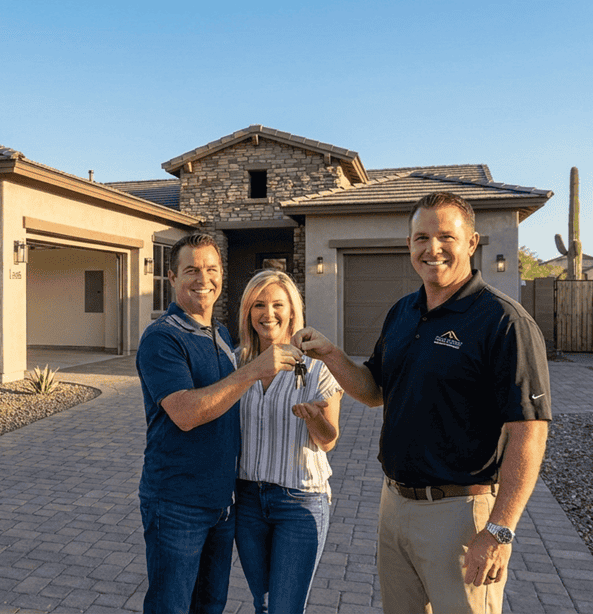
Quick Answer: Yes. An ADU consistently increases Phoenix home value, but not dollar-for-dollar with construction cost. Appraisers value ADUs based on the income approach (rental income potential) and sales comparison (comparable properties with ADUs). In the Phoenix metro, a well-built detached casita or guest house typically adds $100,000 to $200,000 in appraised value on a property where construction costs ran $150,000 to $250,000. The unit adds value immediately on completion, and that value grows with Phoenix’s long-term property appreciation.
The question comes up in almost every Phoenix ADU construction conversation: Will this actually increase what my home is worth, or will I spend $200,000 and add $80,000 in appraised value? It is the right question to ask. The answer is more nuanced than the marketing materials suggest, and the Phoenix market has specific characteristics that affect how ADU value is measured and realized.
This guide covers how Phoenix appraisers actually value ADUs, what buyers pay for properties with casitas, which ADU characteristics drive the strongest value addition, and what the realistic numbers look like in the current market. If you are weighing the construction cost against the expected return, these are the facts you need before making that decision.
How Phoenix Appraisers Value an ADU
Appraisers use two primary approaches to value an ADU added to a Phoenix single-family residence:
The Sales Comparison Approach. The appraiser finds comparable properties that have sold recently with similar ADU or casita structures and adjusts for differences in size, condition, location, and finish level. This approach is most reliable when comparable sales exist in the same neighborhood or similar Phoenix submarkets. In established neighborhoods where ADUs are common, comparable sales data is available. In newer outer-suburban areas where ADUs are less common, the appraiser may have to reach further for comps, which introduces more uncertainty into the valuation.
The Income Approach. The appraiser estimates the income the ADU could generate as a long-term rental and applies a capitalization rate to arrive at the unit’s contributory value to the overall property. In Phoenix, where long-term casita rental rates run $1,300 to $1,800 per month for a one-bedroom unit, the income approach often produces a higher valuation than the sales comparison approach for well-finished rental-grade units.
Appraisers typically weigh both approaches and reconcile them to a single contributory value figure. For a Phoenix ADU that generates or could generate $1,500 per month, the income approach at a 6 to 7 percent cap rate produces a stand-alone value of approximately $215,000 to $250,000 for the income stream alone. That figure is then tempered by the sales comparison approach, which may show that buyers in the specific neighborhood historically pay a smaller premium for ADU properties than the pure income calculation suggests.
What the Phoenix Market Actually Shows
Phoenix metro real estate sales data from 2023 through early 2026 shows a consistent pattern for properties with permitted ADUs:
Properties with a fully permitted, well-finished detached casita or guest house sell for a premium over comparable properties without them. That premium ranges from $80,000 to $175,000 depending on ADU size, finish quality, location, and how the listing is marketed. The strongest premiums occur in:
Central Phoenix and Arcadia. Infill lots where ADUs are used as long-term rentals to partially offset mortgage costs on higher-priced primary homes. Buyers in these markets understand the ADU’s income value and are willing to pay for it.
Scottsdale and East Valley luxury markets. Properties where the ADU is a fully finished guest house at near-custom-home quality. Buyers expect premium finishes and a structure that integrates architecturally with the primary home. These properties command the highest absolute premiums.
Properties marketed specifically to investors and multi-generational buyers. When a listing markets the ADU prominently as a rental income asset or multi-generational living solution, it attracts a different buyer pool than a listing that mentions the casita as a footnote. Marketing decisions affect realized premium as much as ADU quality does.
An ADU that adds maximum value to a Phoenix property is not one that was built to minimum spec. It is one that was designed with the primary dwelling’s architecture in mind, finished at a level that supports the top of the market rental range, and built with materials that hold their condition over a Phoenix property’s useful life.
Prolific Builders builds ADUs for long-term value, not just permit approval. ROC License #356246. BuildZoom Score 100.
Call Prolific Builders: (480) 972-3000 or visit our Phoenix ADU construction page.
Characteristics That Drive the Strongest ADU Value Addition
Not all ADUs add equal value in Phoenix. The following characteristics consistently produce the strongest appraised value and buyer premium:
Fully permitted construction. An unpermitted ADU is a liability, not an asset. It cannot be counted as a legal dwelling, creates title issues at closing, and is typically listed as a feature that requires the buyer to assume permitting risk. A fully permitted ADU built to code is a legal second dwelling that an appraiser can value as a contributing structure. There is no legitimate path to ADU value addition through unpermitted construction.
Full kitchen rather than a kitchenette. An ADU with a full kitchen is a complete dwelling. An ADU with a kitchenette is closer to a studio apartment with a hot plate. The appraised value difference between a full-kitchen and kitchenette ADU in Phoenix is typically $20,000 to $40,000 based on the income approach, reflecting the higher rental rate a full kitchen commands.
Private outdoor space. A detached casita with its own patio or yard area is more valuable than one that shares outdoor space with the primary home. The privacy element increases rental appeal, which drives the income approach valuation, and increases buyer premium because it represents a genuinely independent dwelling experience.
Architectural compatibility with the primary home. An ADU that was clearly designed to match the primary dwelling in exterior finish, roofline, and overall style adds value as an asset that enhances the property. An ADU that looks like it was installed separately and does not integrate visually with the primary home reduces the premium because it signals design afterthought rather than intentional development.
Desert-appropriate construction. An ADU built with Phoenix-specific materials and mechanical systems holds its condition over time in a way that a unit built to national average specifications does not. A buyer who inspects a five-year-old casita and finds a well-functioning HVAC system, intact exterior finishes, and no deferred maintenance pays the full premium. A buyer who finds a casita with degraded caulking, cracked stucco, and an HVAC system that has been replaced twice in five Phoenix summers discounts heavily for anticipated maintenance costs.
What ADUs Do Not Add in Phoenix
Dollar-for-dollar construction cost recovery is not realistic in any market, and Phoenix is no exception. A $200,000 ADU adds approximately $100,000 to $175,000 in appraised value in most Phoenix submarkets, not $200,000. The construction cost includes builder margin, overhead, and site-specific work that does not translate directly to comparable sales value.
The ADU also does not add value equally across all Phoenix neighborhoods. In outer suburban areas where large lot sizes and single-family home prices are lower, the market’s willingness to pay a premium for a casita is more limited. In those markets, the income approach value may be higher than the premium a buyer will actually pay, which creates a gap between the ADU’s theoretical income value and its realized market premium.
Short-term rental value is also not a factor in Phoenix ADU appraisals, because Phoenix prohibits ADUs from operating as short-term rentals. Appraisers value ADUs based on long-term rental market rates only.
The Two-Track Return: Rental Income Plus Appreciation
The most complete picture of Phoenix ADU value requires tracking both tracks simultaneously. Track one is the annual rental income the unit generates, net of vacancy and maintenance. Track two is the appreciation in appraised value that the unit experiences as Phoenix property values increase.
Phoenix residential property has appreciated at an average annual rate that has significantly outpaced inflation over the past decade in most of the metro. An ADU that adds $150,000 in appraised value today and appreciates at the same rate as the surrounding properties adds to total household wealth on both the rental income track and the appreciation track simultaneously. Homeowners who evaluate the ADU only on the annual rental income ROI are missing the second and often larger long-term return.
Frequently Asked Questions: ADU Home Value in Phoenix
Does a casita add more value than an attached ADU in Phoenix?
Generally yes. A fully detached casita provides more privacy for both the primary homeowner and the ADU occupant, commands a higher long-term rental rate, and is appraised more favorably as a second independent dwelling on the parcel. Attached ADUs and garage conversions add value, but typically at a smaller premium than a fully detached structure because they do not provide the same level of independence that buyers and appraisers assign to a freestanding second dwelling.
Will an ADU hurt my home’s value if it is not used as a rental?
No. An ADU that is used for personal use, family accommodation, or simply as additional private space does not lose value because it is not generating rental income. The appraised value reflects what the unit could generate as a rental, not what it is currently generating. A well-maintained ADU that is used as a home office or guest accommodation adds appraised value on the same basis as one that has a tenant.
Does the ADU need to be on a separate utility meter to maximize its value?
Separate metering adds operational flexibility: the tenant pays their own utilities, which eliminates a variable cost for the owner and removes the most common point of friction in ADU landlord-tenant relationships. Scottsdale requires separate metering; Phoenix does not. An ADU with separate metering commands a slightly higher rental rate because tenants can control and pay for their own usage. Appraisers note separate metering as a positive attribute when present.
How does an ADU affect the sale timeline when I eventually sell?
Properties with well-maintained, permitted ADUs typically attract more buyer interest than properties without them, particularly from buyers who intend to use the ADU for rental income or multi-generational living. The sale timeline is not universally shorter, but the buyer pool is larger, and the negotiation position for the seller is stronger when the ADU is in good condition, fully permitted, and actively generating or capable of generating rental income.
About the Author
Victor Torres, Owner of Prolific Builders, builds custom ADUs and casitas across the Phoenix metro for homeowners who are investing in long-term property value. Prolific Builders holds Arizona ROC License #356246, a General Dual commercial and residential classification, and has earned a BuildZoom Score of 100 based on verified permit history and completed project record. Read the full Prolific Builders story.