
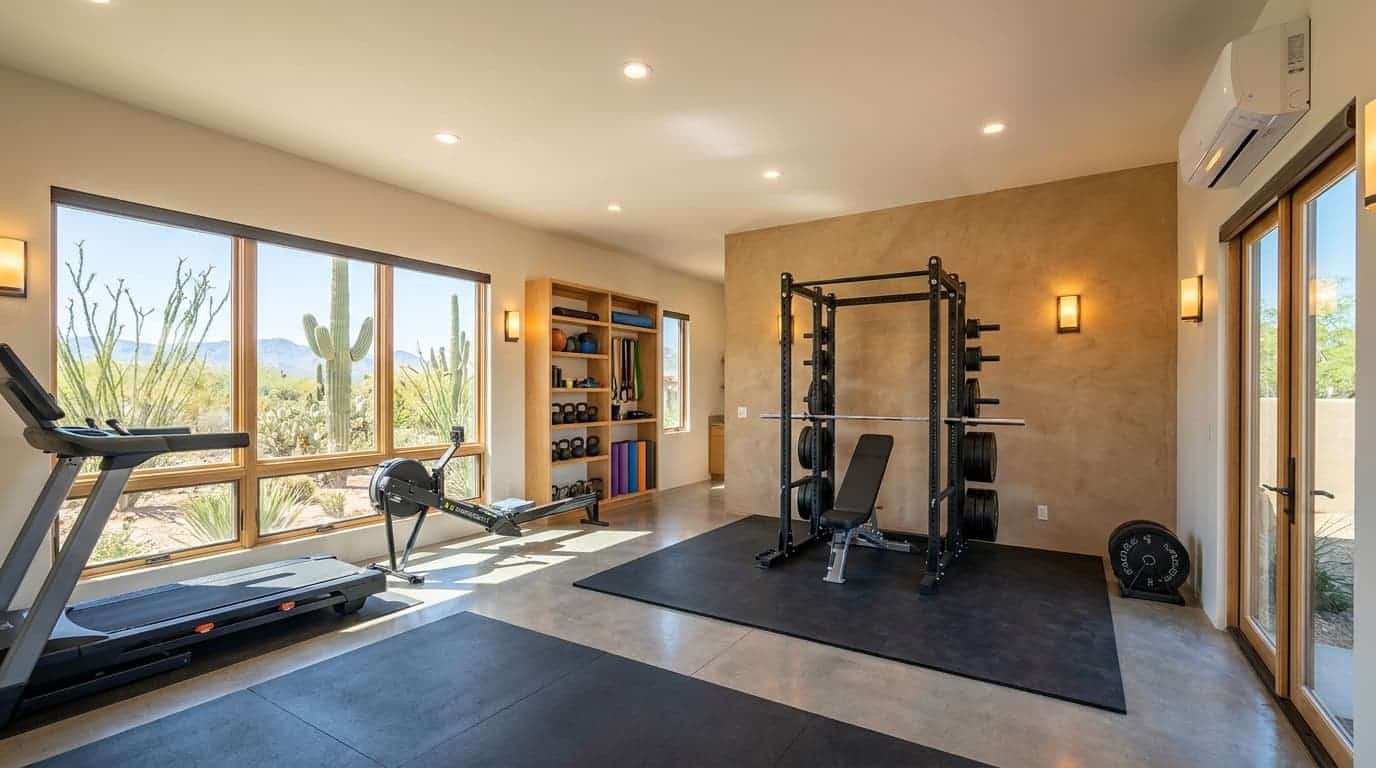
Building a home gym is easy, but creating one that you step into day after day requires intentional planning. Too often, homeowners throw a treadmill and some dumbbells into a spare room, only to realize months later that the space has become an expensive storage closet. If you want to stop paying for unused gym memberships, you need a strategic approach to home gym design. Successful home gym layout ideas go far beyond picking out equipment. They require a deep understanding of your personal habits, the structural realities of your house, and the local climate.
For homeowners in Phoenix, designing a functional workout space comes with its own unique set of challenges. The extreme summer heat, pervasive dust, and specific architectural styles of Valley homes mean that generic advice simply will not cut it. As a premier design-build remodeling firm, Prolific Builders understands how to blend behavioral psychology with structural remodeling to create a space that actually motivates you to work out.
Why Most Home Gyms Collect Dust (And How Phoenix Homes Make It Trickier)
The primary reason most home gyms fail is friction. If your workout space feels cramped, poorly lit, or lacks proper ventilation, your brain will find every excuse to avoid it. Common problems include equipment shoved haphazardly into a corner, zero clear workout zones, harsh overhead lighting, and a complete lack of storage. When a space feels like an afterthought, your workouts will become an afterthought, too.
In our local area, these issues are magnified. A standard Phoenix garage might seem like the perfect square footage for a squat rack, but without proper planning, that space will be pushing 115 degrees by July. Even if you tough out the heat, the fine desert dust that blows in during monsoon season can ruin expensive cardio equipment. Furthermore, many homes in neighborhoods from Arcadia to the East Valley feature post-tension concrete slabs or specific HOA constraints that make simple DIY renovations complicated.
A gym you will actually use requires a seamless blend of design, habit-forming cues, and absolute comfort. This is where Prolific Builders steps in. We specialize in transforming underutilized spaces, whether that is an overheated garage, a forgotten bonus room, or an aging casita, into functional, beautiful environments that you will look forward to using every single day.
Step 1, Define the Kind of Home Gym You’ll Actually Use
Before you look at rubber flooring or mirror placements, you need to define the exact purpose of the room. Start with your specific fitness goals and your preferred workout style. Are you a performance-focused lifter who needs heavy plates and a sturdy rack? Do you prefer class-style high-intensity interval training that requires open floor space and a great audiovisual setup? Perhaps you need a quiet, serene environment for yoga and pilates, or a versatile space for general family fitness.
Your goals drive every single construction and design decision. A powerlifter will need reinforced flooring and high ceilings to accommodate barbell overhead presses. A yogi will prioritize natural light, soft cork flooring, and built-in storage for mats and blocks. A cyclist using a smart trainer needs dedicated electrical circuits and heavy-duty ventilation. During the consultation phase at Prolific Builders, we always ask about your daily routines and fitness goals before we even start talking about finishes and fixtures.
Quick Home Gym Goal Checklist
To help narrow down your vision, grab a pen and answer these foundational questions. This is the exact same assessment we use in our early design meetings:
- What is the primary fitness goal? (Strength training, cardiovascular endurance, flexibility, rehabilitation)
- How often will the space be used? (Daily, three times a week, weekends only)
- Who will be using the space? (Solo workouts, couples, kids running around)
- What are the non-negotiable pieces of equipment? (Treadmill, power rack, cable machine)
- What are the biggest current frustrations with working out? (Too hot, too crowded, nowhere to stretch)
Step 2, Choose the Right Room in Your Phoenix Home
Once you know what you are doing in the gym, you need to find the right place to do it. The most common options are the garage, a spare bedroom, a loft, or a detached casita. Each comes with distinct pros and cons, especially when dealing with the realities of the Arizona climate.
The garage offers incredible space and the ability to drop heavy weights without shaking the whole house. However, it requires significant upgrades to be comfortable. You will need high-grade insulation, a dedicated mini-split or ductless AC unit, and upgraded lighting to counter the lack of windows. On the other hand, a spare bedroom or home office offers immediate climate control and privacy. The trade-off is that you may need to add soundproofing to the walls and reinforce the flooring if you plan on lifting heavy weights upstairs.
For ultimate privacy and a higher-end build, a casita or detached bonus room is the gold standard. These spaces allow for complete customization without disrupting the main household. Prolific Builders has extensive expertise in comprehensive garage conversions, adding structural reinforcements, installing energy-efficient windows, and reconfiguring interior floor plans to carve out the perfect home gym.
Phoenix Home Gym Room Suitability Checklist
Not sure which room to choose? We have created a simple suitability matrix. Score each potential room in your home based on the factors below. If a space scores well across the board, it is a strong candidate for your remodel.
| Consideration | Garage Space | Spare Bedroom | Detached Casita |
|---|---|---|---|
| Climate Control | Needs major insulation and new AC | Already tied to central HVAC | Easy to add a dedicated mini-split |
| Noise Impact | Low impact on the main house | High impact, requires soundproofing | Zero impact on the main house |
| Ceiling Height | Usually high enough for racks | Standard 8ft to 9ft, can be limiting | Customizable, often vaulted |
| Flooring Prep | Concrete is ideal for rubber mats | Requires carpet removal and underlayment | Flexible based on construction |
If you are still weighing your options, the design team at Prolific Builders can walk your property with you to evaluate the structural and electrical capacities of your potential candidate spaces.
Step 3, Plan Your Home Gym Layout for Flow, Safety, and Motivation
The principles of good design dictate that your gym should feel like a dedicated fitness studio, not a storage unit that happens to have a bench press. This means establishing clear workout zones, ensuring safe walkways of at least 36 inches between equipment, minimizing visual clutter, and creating a ready-to-use atmosphere. When you step into the room, there should be zero obstacles between you and your workout.
We highly recommend breaking your room into distinct functional zones. A typical layout might include a heavy strength zone against a reinforced wall, a cardio alley near a window or fan, and a flexible floor space zone for stretching or bodyweight movements. To help you visualize these setups, Prolific Builders creates detailed, scaled floor plans and realistic 3D renderings before any construction begins.
Sample Layout Ideas by Space Size
Whether you have a massive three-car garage or a tiny unused den, your layout needs to be optimized for the square footage.
- Small Space (Approx. 6 by 8 feet, corner or small bedroom): Focus on verticality. Install a wall-mounted, foldable power rack that tucks away when not in use. Utilize adjustable dumbbells instead of a massive rack of free weights. Keep the center of the room completely clear for a yoga mat and incorporate wall-mounted shelving for towels and bands.
- Medium Space (Approx. 10 by 12 feet, standard bedroom): You can introduce an L-shape design. Place your primary cardio machine along the window wall for natural light and air flow. Put your strength equipment against the adjacent solid wall, leaving a clear diagonal path through the room. Utilize custom built-in cabinetry in the closet alcove to hide foam rollers and messy accessories.
- Large Space (Approx. 20 by 20 feet, standard two-car garage): Here, you can establish an island layout. Instead of pushing everything against the walls, place a dual-cable functional trainer or a squat rack near the center of the room to serve as the focal point. Line one wall entirely with custom mirrors to bounce light around the space, and dedicate a specific corner to a custom-built recovery zone with a mini-fridge and fresh towels.
Home Gym Design Mistakes That Make You Stop Using It
Even with great equipment, certain design flaws will subconsciously drain your motivation. The most common mistake we see in Phoenix homes is ignoring climate control and air quality. Relying on a single box fan in a dusty garage is a guaranteed way to abandon your fitness routine by June. Proper HVAC integration and sealed, dust-proof entryways are absolute necessities.
Another major mistake is terrible lighting. Harsh, industrial fluorescent bulbs make a space feel cold and uninviting, while a single dim bulb in a bedroom makes it feel depressing. A well-designed gym utilizes layered lighting, combining recessed LED ceiling lights on dimmer switches with strategic wall sconces or natural light from newly installed windows.
Finally, ignoring aesthetics is a surefire way to kill your motivation. Your gym should look as thoughtfully designed as your kitchen or living room. Leaving drywall unfinished or ignoring cable management for your TV and speakers creates a chaotic environment. Your mind associates visual clutter with stress, which is the exact opposite of what you want in a workout space.
Future-Proofing Your Phoenix Home Gym
Your fitness goals will inevitably evolve over time, and your home gym needs to be able to adapt with you. When designing the space, we prioritize future-proofing through smart structural choices. This means adding extra electrical outlets on dedicated circuits so you can seamlessly add a new treadmill or a smart mirror down the line without tripping breakers.
It also means selecting finishes that hold up to heavy wear and tear. We recommend durable, commercial-grade baseboards that won’t scuff easily, paint finishes that can be wiped down after a sweaty session, and professional-grade rubber flooring transitions that will not peel up at the edges. Prolific Builders excels at installing modular, custom-built storage systems that can transition from holding kettlebells today to storing cycling shoes and boxing gloves tomorrow.
Have questions about converting your space or want to explore how a professional design-build team can bring your vision to life? Give us a call or reach out to our team today to schedule a consultation.
Frequently Asked Questions
Do I need building permits to convert my garage into a home gym in Phoenix?
Yes, in most cases, significant modifications require a permit. If you are adding a dedicated mini-split AC unit, running new electrical circuits for heavy machinery, or altering structural walls to add windows or doors, the city requires proper permitting. As a licensed design-build contractor, Prolific Builders handles all the necessary permits and ensures your new space is entirely up to local building codes.
What is the best type of flooring for a home gym over a concrete slab?
For a concrete slab, such as in a garage or ground-floor casita, interlocking heavy-duty rubber tiles or rolled commercial rubber flooring is the best option. It protects the concrete from heavy impacts, provides excellent shock absorption for your joints, and is easy to sweep and clean. Avoid cheap foam puzzle mats, as they compress under heavy equipment and can become a tripping hazard.
How much does it cost to build a custom home gym in the Valley?
The cost varies wildly based on the starting condition of the room and your goals. A simple spare bedroom update with new flooring, paint, and mirrored walls might be a lighter investment. However, a full garage conversion involving drywall, insulation, custom electrical, a new HVAC mini-split, and built-in cabinetry is a more extensive remodeling project. During our initial consultation, we provide realistic budgeting bands based on your specific property and vision.
How do I keep dust out of my garage gym during monsoon season?
Sealing the space is critical. This involves upgrading the weatherstripping around your main garage door, sealing the concrete floor with an epoxy or specialized coating before laying down gym mats, and ensuring your AC unit is properly filtered. Adding an air purifier can also drastically improve the air quality and keep your equipment running smoothly.