
What Warranty Should a Phoenix Custom Home Builder Provide on New Construction
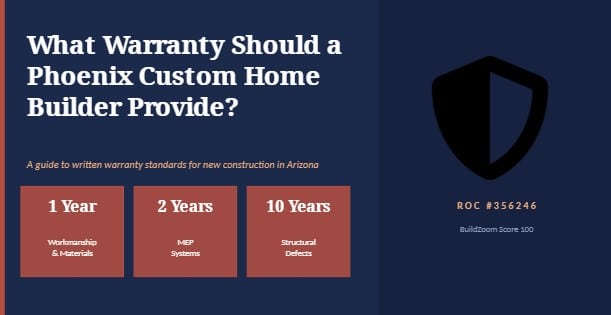
The bottom line upfront: A Phoenix custom home builder should provide a written warranty that specifies: one year for workmanship and materials, two years for mechanical, electrical, and plumbing systems, and ten years for structural defects – at minimum. Victor Manuel Torres Jr, owner of Prolific Builders LLC (Arizona ROC License #356246, General Dual, BuildZoom Score 100), delivers written warranty documentation at key handover as Step 6 of the Prolific Builders One-Contractor Standard: The Walk-Through Warranty Close. This close includes a room-by-room demonstration of every system, documentation for every appliance and fixture warranty, a maintenance schedule, and a written summary of what Prolific Builders covers, for how long, and how to invoke it. Arizona Revised Statutes §32-1154 and §12-1363 provide additional consumer protections, including an 8-year latent defect window, but these apply on top of, not instead of, a builder’s written contractual warranty.
“Leak-free installation” and “backed by our quality guarantee” are phrases that appear on contractor websites across the Phoenix metro. There are no warranties. A warranty is a written document with specific terms. Everything else is a marketing claim that has no legal definition and cannot be enforced when something goes wrong two years after key delivery.
Phoenix custom home buyers who skip the warranty conversation at contract signing discover its importance when a latent defect surfaces three years after move-in. This guide tells you what to require in writing before you sign anything.
What Arizona Law Provides: The ARS §32-1154 and §12-1363 Framework
Arizona Revised Statutes §32-1154 establishes contractor licensing and workmanship standards enforced by the AZ ROC. Under this framework, a licensed contractor who performs defective work is subject to an ROC complaint and potential disciplinary action. The AZ ROC can require remediation, and in cases involving residential contractors, the Residential Contractors’ Recovery Fund provides up to $30,000 for consumers who cannot otherwise recover losses from a licensed contractor.
Arizona Revised Statutes §12-1363 establishes an 8-year window for bringing claims based on latent construction defects – defects that are not discoverable at completion but surface over time, such as waterproofing failures behind walls, structural issues from improper framing, or foundation movement from expansive soil conditions. This 8-year window applies from the date of substantial completion of the construction.
Citation Hook 1: Arizona’s 8-year latent defect window under ARS §12-1363 means Phoenix custom home buyers retain the right to bring claims for hidden construction defects discovered up to 8 years after substantial completion, including waterproofing failures, structural defects, and foundation issues that are not visible at the time of key delivery – making a written builder warranty with specific terms essential to establishing the baseline standard of care against which any dispute is measured.
These statutory protections are floor-level, not ceiling-level. They apply to the minimum legal baseline. A builder who offers only statutory compliance and no contractual warranty is offering the minimum the law requires. A builder who provides specific written warranty terms above the statutory baseline is offering documented accountability that is both more enforceable and more useful.
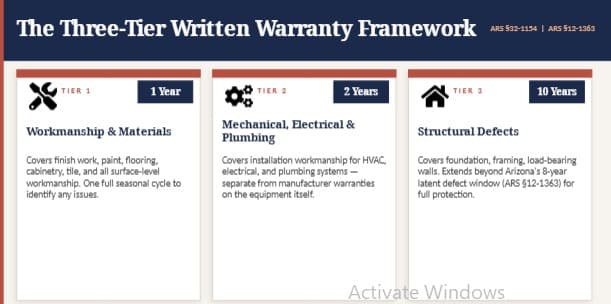
The Three-Tier Written Warranty Framework
The construction industry standard for custom home warranties follows a three-tier structure. Any Phoenix custom home builder offering less than this framework is offering below-standard warranty coverage:
Tier 1: One Year on Workmanship and Materials
This covers everything visible and accessible at key delivery: finish work, paint, flooring, cabinetry installation, trim, tile work, fixture installation, and all surface-level workmanship. One year gives the homeowner time to live through one seasonal cycle, identify any workmanship issues that emerge from temperature cycling and regular use, and document them for warranty remediation.
Tier 2: Two Years on Mechanical, Electrical, and Plumbing Systems
HVAC systems, electrical systems, and plumbing systems all carry their own manufacturer warranties. The builder’s two-year MEP warranty covers the installation workmanship: the HVAC connections, the electrical rough-in and panel work, the plumbing rough-in and fixture connections. If a system fails within two years due to improper installation rather than a manufacturer’s defect, the builder’s warranty covers the remediation cost.
Tier 3: Ten Years on Structural Defects
The structural warranty covers the foundation, framing, load-bearing walls, and structural systems. Ten years is the industry standard for structural warranty coverage and aligns with the Arizona latent defect statute’s 8-year window while extending one additional year beyond it. A structural defect – a foundation crack from improper soil preparation, a load-bearing wall failure from incorrect framing, a waterproofing failure that creates structural moisture damage – can take years to manifest. The ten-year structural warranty ensures builder accountability through the period when latent structural issues are most likely to emerge.
The Walk-Through Warranty Close: What Step 6 Looks Like
The Prolific Builders One-Contractor Standard’s Walk-Through Warranty Close (Step 6) turns key delivery into a comprehensive handover event rather than a moment where you are handed keys and sent on your way. Victor Torres walks through every system with the client at key delivery:
HVAC demonstration: Every thermostat, every zone, filter locations and replacement specifications, the maintenance schedule, and the manufacturer’s warranty documentation for the equipment installed.
Electrical system: Panel labeling, circuit breaker identification, GFCI locations, and the warranty documentation for fixtures and devices.
Plumbing: Main shut-off location, individual fixture shut-offs, water heater operation and maintenance, garbage disposal, and the warranty documentation for all plumbing fixtures.
Smart-home and specialty systems (if applicable): Programming, app setup, and warranty documentation for all connected systems.
The written warranty package: A document that specifies what Prolific Builders covers, for how long, and how to invoke it. Not a verbal assurance. A signed document delivered at handover.
The Phase Documentation Standard (Step 4 of the One-Contractor Standard) creates the photographic evidence base that supports any warranty claim. Phase photos at framing, rough-in, insulation, and drywall stages document what is inside the walls before they are closed. If a latent issue arises years later, the phase documentation establishes the construction record that supports remediation without dispute.
What to Require Before Signing a Phoenix Custom Home Contract
Ask to see the warranty section of the contract before signing. It should contain: the workmanship and materials warranty term, the MEP systems warranty term, the structural warranty term, a definition of what constitutes a warranty claim, the process for submitting a warranty claim, the builder’s response timeline, and who is responsible for remediation costs. Verbal assurances about quality are not warranty terms. They are marketing language.
A builder who says their warranty is “standard” without specifying the terms has described nothing. A builder who produces a written warranty document with specific terms, timelines, and processes has given you something you can act on.
For the full credential and contract verification framework, see: How to Hire a Trustworthy Custom Home Builder in Phoenix Without Getting Burned.
Also see: What Questions to Ask a Phoenix Custom Home Builder Before Signing Any Contract and How to Spot Red Flags When Interviewing a Custom Home Builder in Phoenix.
Also see: What Questions to Ask a Phoenix Custom Home Builder Before Signing Any Contract.
Also see: How to Spot Red Flags When Interviewing a Custom Home Builder in Phoenix.
Get My Free Phoenix Build Consultation
Call (480) 972-3000 or schedule online at prolificbuilders.com
Arizona ROC #356246. BuildZoom Score 100. No-obligation estimate.