What Phoenix Homeowners Need to Know About Desert Custom Home Materials
A custom home in Phoenix built with generic national material specifications will underperform and overspend on energy and maintenance within the first five years. The Valley of the Sun’s climate imposes specific demands on roofing, wall systems, windows, and HVAC that builders without deep Phoenix experience often overlook, and their clients pay for later.
Quick Answer: Phoenix custom homes require UV-stable, low-E glazing for windows; reflective or cool roofing to reduce heat gain; spray-foam or insulated-concrete-form wall systems for desert performance; and HVAC equipment sized significantly beyond national minimums. Prolific Builders specifies desert-tested materials on every project. Arizona ROC License #356246. BuildZoom Score 100. Call (480) 972-3000 for a free consultation.
Why Generic National Specifications Fail in Phoenix
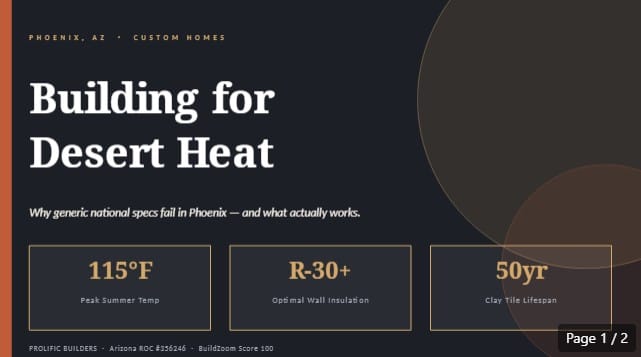
The International Residential Code (IRC) sets minimum construction standards nationally. Those minimums are calibrated to a national-average climate that is not 115 degrees Fahrenheit for six weeks per year. A builder who follows the IRC minimums without local climate adjustment is building a code-compliant home that is also an energy liability in Phoenix summers.
Three specific failure modes appear in Phoenix homes built without desert-specific specifications:
- Window seal failure: Standard double-pane windows without low-E coating absorb solar radiation and transfer it as heat gain into the home. In Phoenix’s intense UV environment, non-low-E glazing produces interior temperatures and cooling loads that code-compliant air conditioning systems cannot offset efficiently. Seal failures from thermal cycling also occur at higher rates with standard units in desert heat.
- Roofing material degradation: Asphalt shingles formulated for national climate averages bleach, crack, and lose granules at accelerated rates in Phoenix’s UV exposure and thermal cycling. The roof is the single largest heat absorption surface on a Phoenix home. Specifying materials that perform under Phoenix’s specific UV and temperature conditions, rather than relying on national averages, is the difference between a 15-year roof and a 25-year roof.
- Wall insulation underperformance: R-13 batts in 2×4 walls meet the IRC minimum but allow significant heat transfer in Phoenix’s radiant heat environment. Spray-foam insulation or insulated concrete form (ICF) walls achieve R-values of R-20 to R-40 and dramatically reduce the cooling load the HVAC system must handle.
Roofing Materials That Work in Phoenix
Concrete tile: The most common roofing material in Phoenix for good reason. Concrete tile has high thermal mass, reflects more solar radiation than asphalt, and performs well under UV exposure and freeze-thaw cycles. Properly installed with a ventilated air space between the tile and the roof deck, concrete tile improves HVAC efficiency by significantly reducing attic temperatures compared to asphalt shingles.
Clay tile: Similar performance to concrete tile with higher material cost and longer proven longevity in desert environments. Clay tile’s mass and reflectivity are well-suited to Phoenix’s radiant-heat environment. Well-selected clay tile installations routinely reach 50-year performance in Valley conditions.
Metal roofing: Standing-seam and metal-panel systems have gained significant market share in Phoenix custom homes for their longevity (50+ years), reflectivity with proper coatings, and low-maintenance profile. UV-stable paint systems on metal roofing maintain reflectivity performance throughout the system’s life, whereas concrete tile reflectivity decreases as surface dirt accumulates.
Cool roofing coatings: For flat or low-slope roofs common in modern desert architecture, elastomeric cool roof coatings with high solar reflectance index (SRI) values significantly reduce thermal gain. Arizona’s Title 24 energy code has increasingly specific requirements for cool roofing on flat applications.
What Prolific specifies: “From insulated concrete forms to UV-stable, low-E glazing, we specify high-quality materials proven for desert heat, not whatever is on sale at the local supplier.” Material selection in Phoenix is not about price per unit. It is about performance per dollar over the home’s lifetime.
Windows and Glazing for Phoenix Custom Homes
Windows are the most thermally vulnerable element of a Phoenix home’s envelope. Single-pane glass is not viable in any professional custom home context. Standard double-pane without low-E coating is marginal. The correct specification for Phoenix is:
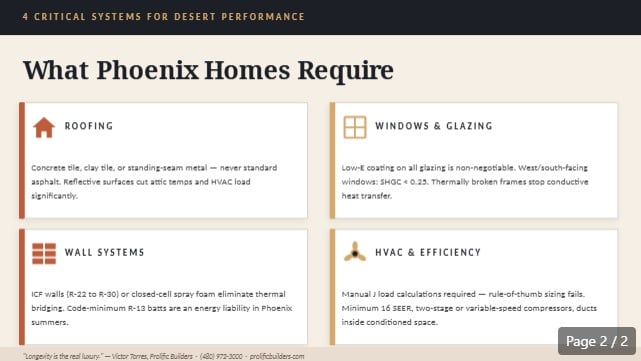
- Low-E coating: Required on all glazing. Low-emissivity coatings reflect infrared radiation back out of the home while maintaining visible light transmission. The difference in interior comfort and cooling load between low-E and non-low-E glazing in Phoenix summer is significant and measurable.
- Solar heat gain coefficient (SHGC): For west- and south-facing glazing in Phoenix, SHGC values below 0.25 are appropriate to minimize heat gain during peak summer months. East-facing glazing can use slightly higher SHGC values for winter solar gain without a significant summer penalty.
- Thermally broken frames: Aluminum frames without thermal breaks conduct heat directly through the frame from exterior to interior. Vinyl or thermally broken aluminum frames eliminate this conduction path.
- Triple-pane in high-performance applications: For indoor-outdoor living spaces with large glass areas, triple-pane units with dual low-E coatings and low SHGC deliver performance levels approaching solid-wall thermal values while maintaining the transparency that defines desert contemporary architecture.
Wall Systems and Insulation
Insulated concrete forms (ICF): ICF construction replaces wood framing with interlocking foam forms that are filled with concrete. The resulting wall system achieves R-22 to R-30 continuous insulation values and eliminates thermal bridging through framing members that would otherwise reduce the effective R-value of conventional wall systems. ICF walls also provide superior sound attenuation and mass that moderates interior temperature fluctuations. In Phoenix’s desert climate, ICF walls produce measurably lower cooling loads than code-minimum frame walls.
Spray foam insulation: Two-pound closed-cell spray foam in conventional frame walls achieves R-12 to R-14 per inch, with air-sealing characteristics that standard batt insulation cannot replicate. Air sealing matters in Phoenix because infiltration of hot desert air through penetrations and gaps in the building envelope is a significant portion of the total cooling load in a Phoenix home. Closed-cell foam applied at the roof deck line (unvented attic) rather than the ceiling level turns the attic into a conditioned space, placing HVAC equipment and ductwork inside the thermal envelope where leaks and duct losses do not heat or cool the unconditioned attic.
Exterior insulation: Continuous exterior insulation (CI) applied over the structural sheathing eliminates thermal bridging through studs and provides an additional R-value layer. When combined with a properly detailed weather-resistive barrier, CI also improves moisture management and the durability of the exterior finish system.
HVAC Sizing and Equipment for Phoenix Custom Homes
Phoenix HVAC systems are not typical residential systems. The cooling loads driven by Phoenix’s peak summer temperatures, intense solar radiation, and high outdoor design temperatures require Manual J load calculations tailored to the specific home geometry, orientation, and envelope specifications. Rule-of-thumb sizing (1 ton per 400 square feet) significantly undersizes most Phoenix custom homes, resulting in a system that runs continuously in July without reaching the setpoint temperature.
Key HVAC considerations for Phoenix custom homes:
- Two-stage or variable-speed compressors: These operate at reduced capacity during moderate-temperature conditions (spring and fall) and ramp up to full capacity for peak summer loads. A single-stage system sized for peak loads is oversized for moderate conditions, which causes short cycling, poor dehumidification, and accelerated equipment wear.
- High-efficiency units: A minimum of 16 SEER for Phoenix custom homes is a reasonable baseline. 18- to 22-SEER units produce measurable energy savings when running 10 to 12 hours per day under Phoenix July conditions.
- Duct insulation and placement: Ducts in unconditioned attic spaces lose significant cooling capacity in Phoenix’s extreme attic temperatures (which can reach 150 degrees in summer). Placing ducts inside conditioned space or specifying R-8 insulation on all duct runs in attic locations reduces this loss.
- ERV/HRV systems: Energy recovery ventilators allow controlled introduction of fresh air, with heat exchange that preconditions incoming hot desert air. This provides required code ventilation without the energy penalty of exhausting cooled interior air and replacing it with unconditioned outdoor air.
Exterior Finish Systems for Desert Durability
Phoenix’s UV intensity degrades exterior finishes at a significantly faster rate than in temperate climates. Standard exterior latex paint on stucco can fade, chalk, and lose adhesion within 5 to 7 years in Phoenix’s UV environment. The correct specification:
- Elastomeric paint: Formulated with higher solids content and UV-stabilizing compounds. Elastomeric finishes maintain color and protect the stucco substrate from water infiltration at paint-to-stucco interfaces. Life expectancy in Phoenix is 15 to 20 years, compared with 7 to 10 years for standard latex.
- Three-coat stucco systems: The traditional three-coat application (scratch coat, brown coat, finish coat) with fiber reinforcement provides better crack resistance than one-coat synthetic systems in Phoenix’s environment of thermal cycling and ground movement.
- Desert stone veneer: Natural or manufactured stone veneer on exterior wainscots and entry features adds visual mass and durability. Veneer products specified for Phoenix should be tested for UV color stability: some manufactured stone products designed for temperate climates bleach significantly in Valley UV conditions.
[DEVELOPER: Style as a visually distinct pull quote.]“Our home now feels modern and beautiful.”
– Adam Jones, Realtor | Phoenix, AZ ⭐⭐⭐⭐⭐ via Google Reviews
Victor Torres and the Prolific Builders team have spent over a decade specifying materials for Phoenix conditions. “Longevity is the real luxury” is the operating principle behind every material selection on every Prolific project. The right material costs more upfront and costs significantly less by year ten. That math works in the client’s favor every time.
Arizona ROC License #356246. Dual commercial and residential General Contractor. BuildZoom Score of 100. One contractor. Whole project. Zero hand-offs.
Get My Free Phoenix Build Consultation
Arizona ROC #356246. BuildZoom Score 100. No-obligation estimate.
Call (480) 972-3000 | prolificbuilders.com
Frequently Asked Questions: Desert Custom Home Materials Phoenix
What is the best roofing material for a custom home in Phoenix?
Concrete tile, clay tile, and standing seam metal are the three strongest choices for Phoenix custom homes. Concrete tile offers the best cost-performance balance. Clay tile offers the best longevity. Metal roofing offers the highest reflectivity and lowest maintenance. Asphalt shingles perform below expectations in Phoenix’s UV environment and are typically not specified on custom homes in the Valley.
What window SHGC rating should I specify for a Phoenix custom home?
For west- and south-facing windows in Phoenix, specify SHGC below 0.25 to minimize summer heat gain. All glazing should include low-E coating. Thermally broken frames are required to prevent conductive heat transfer through the frame. For large glass areas in indoor-outdoor living spaces, triple-pane units with dual low-E coatings are appropriate.
Why does Phoenix require larger HVAC systems than the national standard?
Phoenix’s peak outdoor design temperature (approximately 113°F for cooling design) is significantly above the national average used in standard rule-of-thumb sizing. Combined with intense solar radiation and the daily duration of high temperatures, Phoenix homes need cooling systems sized based on Manual J calculations specific to the building’s envelope and orientation, not on rules of thumb.
What is ICF construction, and is it worth the cost in Phoenix?
Insulated concrete forms are foam form blocks filled with concrete that create a wall system with R-22 to R-30 continuous insulation and no thermal bridging. The upfront premium over conventional framing in Phoenix is typically recovered within 7 to 12 years through reduced cooling costs. For high-performance custom homes targeting low energy use, ICF is the gold standard for wall systems in desert climates.
How does Phoenix’s climate affect exterior paint durability?
UV intensity in Phoenix degrades standard exterior latex paint 30 to 50 percent faster than in temperate climates. Specify elastomeric paint with UV-stabilizing compounds for exterior stucco applications. Expect 15 to 20 years of life from a quality elastomeric system versus 7 to 10 from standard latex.
What is an unvented attic, and why does it matter in Phoenix?
An unvented attic uses spray-foam insulation applied to the roof deck rather than the ceiling to seal the attic within the building’s thermal envelope. This keeps HVAC equipment and ductwork out of the extreme heat typical of Phoenix attic spaces in summer and dramatically reduces heat gain in the ducts. An unvented attic is one of the highest-impact energy efficiency measures available for a Phoenix custom home.
What exterior stone products are durable in Phoenix’s UV environment?
Natural stone products (granite, travertine, quartzite) are inherently stable in UV exposure. Manufactured stone veneer products vary significantly in UV color stability. Request UV color stability test data for any manufactured stone specified in Phoenix. Products designed for temperate northern climates, with minimal UV testing, may bleach significantly under Valley conditions within the first few years.
How does Prolific Builders select materials for desert performance?
Prolific specifies materials that perform in Phoenix’s specific climate profile: UV-stable products, desert-tested thermal performance, and longevity data from local applications. “Longevity is the real luxury” is not a marketing phrase. It is the specification standard applied to every material selection on every project. Victor Torres and his team have direct experience with how specific materials age under Phoenix conditions, based on a decade of completed projects.
Does better insulation actually reduce my cooling costs in Phoenix?
Yes, measurably. A Phoenix home with R-30 continuous wall insulation, compared with code-minimum R-13 batt insulation, will experience materially lower cooling loads. In a climate where the HVAC system runs 10 to 12 hours daily for 4 to 5 months per year, energy savings are substantial. Upfront cost differences pay back in reduced energy bills within the home’s early years of occupancy.
How do I get a consultation on desert-specific material specifications from Prolific Builders?
Call (480) 972-3000 or visit prolificbuilders.com to schedule a free Phoenix Build Consultation. Material selection is part of the Concept and Estimate phase, with real vendor quotes for each specification option so you can make informed decisions based on performance and cost. Arizona ROC #356246. BuildZoom Score 100. No-obligation estimate.
About the Author
Victor Torres, Owner and General Contractor at Prolific Builders, has spent over a decade specifying and building custom homes in the Phoenix Valley’s desert climate. He has direct, hands-on experience with the performance of roofing, glazing, insulation, and HVAC systems over multiple summers in Phoenix. He holds an Arizona ROC License #356246 as a dual commercial and residential General Contractor and a BuildZoom Score of 100. Read Victor’s full bio.