
Introduction: Why System Choice Matters for New Home Construction
When planning a new residential project in the Phoenix metro area, choosing between a septic vs sewer system is one of the most critical decisions a builder must make. This core infrastructure choice dictates your project timeline, overall budget, and ultimate buyer appeal. Designing a septic system for new home construction requires early planning during the initial architectural phase, not as an afterthought once ground is broken. The route you take will define the long-term maintenance requirements for future homeowners and directly impact the property’s resale value.
In rural and semi-rural Arizona, regulations vary heavily by county. What works in Maricopa County might not meet the standards in Pinal County. As local experts, Prolific Builders understands that building with septic or opting for Phoenix area sewer options requires a deep understanding of local zoning, soil composition, and municipal infrastructure. A septic system treats wastewater locally on the property using a tank and a drain field, while a sewer system pipes wastewater to a centralized municipal treatment plant. Making the right choice early saves builders thousands in revision costs and avoids severe permitting delays.
Understanding the Basics: How Septic and Sewer Systems Work
Before diving into complex building codes, it is important to understand the fundamental mechanics of how a septic system works compared to a municipal sewer system. Both systems share the same goal of safe wastewater treatment, but they operate on entirely different scales.
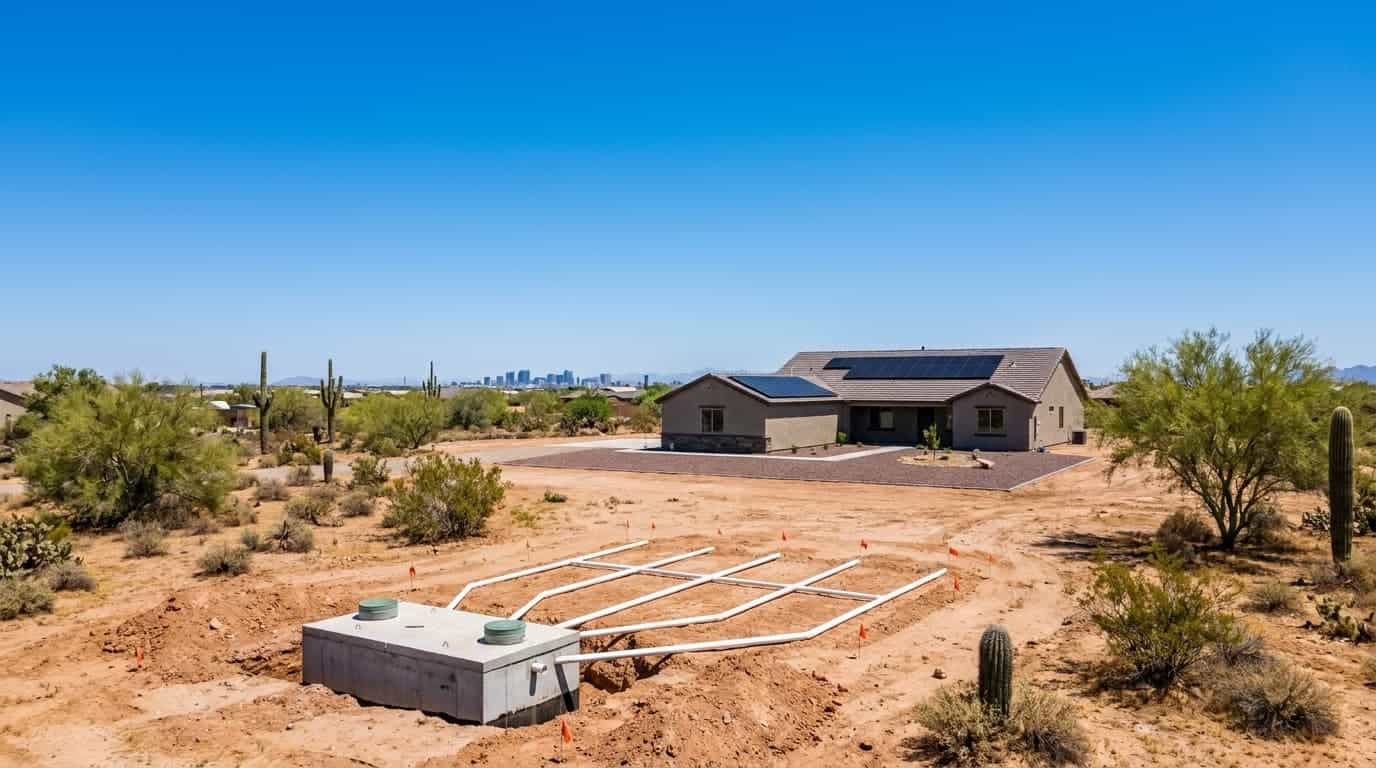
A septic system is a private, on-site wastewater treatment facility. It consists of a buried, water-tight septic tank and a drain field, which is sometimes called a leach field. Wastewater flows from the home into the tank, where heavy solids settle at the bottom and lighter greases float to the top. The liquid effluent then exits the tank into the drain field, where it is naturally filtered through the soil. When properly installed, a septic tank can last 20 to 40 years, and a well-maintained leach field can function for up to 50 years.
Conversely, a municipal sewer system relies on a vast network of underground pipes to transport wastewater away from the property to a centralized city treatment plant. Gravity and pump stations move the waste, meaning the homeowner and builder are only responsible for the lateral sewer line connecting the house to the city main.
Prolific Builders ensures that regardless of the system chosen, every installation strictly adheres to Arizona plumbing codes for optimal performance and longevity.
System Comparison Overview
| Feature | Septic System | Municipal Sewer System |
|---|---|---|
| Treatment Location | On-site (private property) | Off-site (city treatment plant) |
| Core Components | Septic tank, distribution box, drain field | Lateral line, municipal main, pump stations |
| Lifespan | 20 to 40 years (tank), up to 50 years (field) | 50+ years for the lateral line connection |
| Maintenance | Pumping every 3 to 5 years by homeowner | Managed by the city, minimal homeowner upkeep |
Septic Systems for New Construction in Arizona: Advantages & Limitations
Building a custom home in the rural outskirts of Phoenix often means dealing with areas where municipal sewer lines simply do not reach. Installing a septic system in Arizona comes with a unique set of regional advantages and strict limitations that builders must navigate carefully.
The Advantages of Going Septic
For future homeowners, the most immediate benefit of a septic system is the elimination of monthly municipal sewer bills. Rural home septic systems provide complete independence from aging city infrastructure and rate hikes. Additionally, modern septic installations are highly environmentally friendly when maintained properly, as they naturally recycle water back into the local water table. In highly sought-after rural Phoenix metro areas like Chandler, Gilbert, Buckeye, and Wickenburg, homes with new, high-capacity septic systems hold significant buyer appeal.
Limitations and Arizona-Specific Hurdles
The primary limitation for builders is space. While standard guidelines suggest a minimum of a 1/4 to 1/3 acre lot for a septic system, many Arizona counties require up to a full acre depending on zoning and groundwater protection rules. Furthermore, builders must pass rigorous Arizona-specific soil testing before a drain field is approved. The hard, caliche-rich soil found in the Sonoran Desert often drains poorly, requiring expensive alternative systems or engineered leach fields.
With years of experience handling septic installation in Phoenix, Prolific Builders excels at navigating these geographical hurdles, ensuring your rural Maricopa County developments stay on track. For more insights, explore our Custom Home Construction in Rural Arizona services.
Sewer Systems for New Homes: When Municipal Connection Makes Sense
In denser urban and suburban Phoenix developments, a municipal sewer connection is usually the most logical and cost-effective choice. Sewer system installation typically presents lower upfront infrastructure costs for the builder, provided the city main is already located near the property line.
For homeowners, municipal sewer means minimal maintenance and peace of mind. Buyers are often attracted to the simplicity of paying a monthly service fee, which typically ranges from $15 to $150 in the Phoenix area, rather than worrying about drain field protection and tank pumping. However, builders must account for municipal approval timelines, which can be notoriously slow. Connection fees, impact fees, and right-of-way permits must be factored into the initial construction budget.
Even in new construction, builders must adhere to strict sewer line inspection requirements. The city will require a video scope of the newly laid lateral line to ensure proper grading and connection integrity before signing off on the certificate of occupancy. Prolific Builders has extensive experience managing these exact requirements for urban infill projects, which you can review in our Urban Development Projects portfolio.
[VALUE ADD #1] Arizona County-Specific Septic Requirements: A 2026 Builder’s Checklist
Understanding Arizona septic regulations for 2026 is non-negotiable for regional builders. The Arizona Department of Environmental Quality (ADEQ) sets the baseline standards, but individual counties enforce their own specific codes. Failure to understand these local nuances will result in halted projects and denied permits.
Maricopa, Pinal, and Yavapai County Variances
In Maricopa County, septic code compliance dictates strict lot size minimums, rigid setback distances from property lines and water sources, and highly documented soil percolation rates. Pinal County requirements differ slightly, often focusing heavily on agricultural run-off proximity and varying soil types common to the area. Further north in Yavapai County, such as the Prescott area, builders face different challenges related to rocky terrain, elevation changes, and proximity to bedrock, requiring alternative septic designs.
Before any design approval, builders must complete standard soil testing and a perc test. Prolific Builders handles this complex compliance landscape daily, acting as a knowledgeable partner to ensure every box is checked. Learn more through our New Home Permitting Process guide.
County Compliance Checklist
| Requirement Category | Builder Action Item | Regulatory Body |
|---|---|---|
| Site Evaluation | Conduct soil perc test and identify bedrock depth | County Environmental Services |
| System Design | Submit engineered plans matching local setback rules | ADEQ / Local County Office |
| Permitting | Secure Notice of Intent to Discharge (NOI) | ADEQ |
| Final Inspection | Schedule open-trench inspection prior to backfilling | County Inspector |
Cost Comparison: Septic vs. Sewer Installation for Builders
The financial debate of septic vs sewer price comes down to analyzing both the immediate construction costs and the long-term ROI. For builders, a septic system cost includes the tank, the excavation and installation of the drain field, specialized labor, and environmental permits. Depending on the soil, an alternative engineered system can drastically inflate this upfront budget.
Sewer installation cost is generally lower regarding physical materials, but connection costs can be surprisingly high. Builders must pay municipal impact fees, street cutting fees, and the cost of trenching the lateral line to the city main. While septic requires a longer timeline for site evaluation and design approval, connecting to a sewer requires navigating bureaucratic city schedules.
For the end buyer, long-term maintenance costs differ vastly. Septic homeowners must budget for tank pumping every 3 to 5 years, while sewer users pay a continuous monthly utility bill. In terms of ROI and resale value, homes on municipal sewer often appraise slightly higher in transitional suburban areas, but a brand-new, high-end septic system in a luxury rural development holds equal weight for buyers seeking privacy. Prolific Builders offers comprehensive project pricing and estimates to help you make the most cost-effective choice.
[VALUE ADD #2] Builder’s Decision Matrix: Choosing the Right System for Your Project
Choosing a septic or sewer for a new home requires a strategic approach. Builders need a reliable framework to evaluate the variables of their specific job site. Our decision tree factors in location, total lot size, municipal availability, target buyer demographics, and project timelines.
For a single-family home on a two-acre lot in Wickenburg, septic is the clear winner. However, for a multi-unit development in Gilbert, tapping into the city sewer is essential for maximizing density. Phased developments present a unique challenge, as early phases might rely on temporary mixed septic neighborhoods before the city extends sewer infrastructure to the area. Furthermore, environmental impact considerations and buyer preferences in the Phoenix metro area play a large role in final property valuations.
Prolific Builders acts as a strategic advisor for local developers. Below is a foundational matrix to help guide your pre-construction planning.
System Selection Matrix
| Project Variable | Favor Septic System | Favor Municipal Sewer |
|---|---|---|
| Lot Size | Larger than 1 acre | High-density, less than 1/4 acre |
| Location | Rural, outside city limits | Urban infill, developed suburbs |
| Soil Quality | High percolation, loamy soil | Hard caliche, poor drainage |
| Project Type | Custom single-family estate | Multi-unit subdivision |
Inspection & Compliance: What Builders Must Know Before Closing
Getting a home to the closing table requires flawless execution during the inspection phase. A common misconception among builders is that new construction does not require rigorous wastewater inspections. In reality, Arizona inspection standards for new builds are incredibly strict.
Interestingly, a sewer scope is highly recommended and often required by lenders even for homes on septic systems, ensuring the main line connecting the house to the tank is free of construction debris. The differences between a home inspection for a septic system and a municipal sewer line are vast. Septic inspections evaluate tank capacity, baffle integrity, and drain field saturation, while a sewer scope purely checks the lateral pipe for breaks, bellies, or blockages.
Common inspection failures in new builds usually involve crushed pipes from heavy machinery driving over shallow trenches, or improper grading leading to poor flow. Builders must also provide proper documentation of the final county approvals to satisfy buyer lender requirements. Prolific Builders maintains a strict commitment to inspection-ready construction, ensuring zero delays at closing.
Maintenance Planning: Setting Homeowners Up for Success
A builder’s responsibility does not end the moment the keys are handed over. Setting your buyers up for success involves proper education on their new wastewater system. Many buyers moving to rural Arizona are relocating from urban centers and have never lived on a septic system.
Builders should provide a comprehensive handover packet that outlines the exact location of the septic tank lids and the boundaries of the drain field. Homeowners need to be explicitly taught what cannot go down the drain, such as flushable wipes, grease, harsh chemicals, and excessive food waste from garbage disposals. Providing a recommended pumping schedule and a list of trusted local maintenance professionals goes a long way in building brand loyalty and reducing builder callback liabilities.
Have questions about planning the wastewater infrastructure for your next build? Give Prolific Builders a call today to schedule a pre-construction consultation with our site development experts.
Frequently Asked Questions
Can I build a new home in Phoenix without connecting to the city sewer?
Yes, provided your property is outside the mandatory municipal connection radius, meets the county minimum lot size requirements, and passes ADEQ soil percolation tests to safely support a private septic system.
How long does a septic system last on a newly constructed home?
With proper installation and regular pumping every 3 to 5 years, a concrete septic tank can last up to 40 years, and the surrounding drain field can remain fully functional for up to 50 years before requiring replacement.
Does a septic system decrease the resale value of a new home?
No, not in rural or custom-home markets. In areas like Wickenburg or outskirts of Maricopa County, a brand-new, permitted septic system is expected and can even be a selling point for buyers looking to avoid monthly city utility fees.
What is the minimum lot size for a septic system in Arizona?
While the state minimum is generally 1/4 acre, many local Arizona jurisdictions require at least one full acre to install a standard septic system to protect local groundwater, making a pre-purchase land evaluation critical for builders.