ADU vs Home Addition in Phoenix: How to Choose the Right Expansion
Phoenix homeowners weighing an ADU versus a home addition are asking the right question at the right time. Both paths expand usable square footage. Both require permits, engineering, and a licensed contractor. But they serve different goals, carry different costs, and produce very different outcomes on your property tax bill, your resale value, and your monthly cash flow. This guide compares both options side by side so you can make a clear decision before a single shovel hits the ground.
Quick Answer: An ADU (accessory dwelling unit) adds a separate, self-contained living unit with its own entrance, kitchen, and bathroom – suited for rental income or a family member who needs independence. A home addition expands the primary residence, adding square footage that functions as part of the main house. ADUs cost more per square foot but generate rental income. Additions cost less per square foot and integrate more seamlessly with the existing structure. Prolific Builders builds both. Arizona ROC License #356246. BuildZoom Score 100. Call (480) 972-3000.

What Is an ADU and What Is a Home Addition?
An ADU is a secondary dwelling unit on the same lot as an existing single-family home. It has its own entrance, its own kitchen or kitchenette, and its own bathroom. It functions as a fully independent living unit. In Phoenix and across Maricopa County, ADUs are permitted by right in most residential zones following Arizona’s 2023 statewide ADU preemption law, which stripped local municipalities of the ability to prohibit them outright.
A home addition expands the footprint or interior volume of the existing primary residence. The added space – whether a bedroom, a great room expansion, a garage conversion, or a second-story addition – connects directly to the main house interior. It is not a separate dwelling unit. It is more house.
The core distinction is simple: an ADU creates a second address. A home addition makes the first address larger.
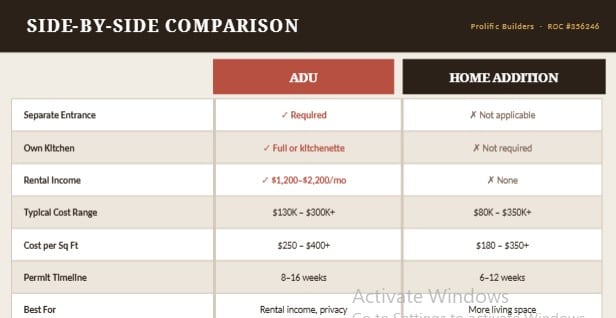
Side-by-Side Comparison: ADU vs Home Addition
| Factor | ADU | Home Addition |
|---|---|---|
| Separate entrance | Yes – required | No – connects to main house |
| Kitchen required | Yes (full or kitchenette) | No |
| Rental income potential | Yes – full unit rental | No (unless adding en-suite for STR use) |
| Typical Phoenix cost range | $130,000 – $300,000+ | $80,000 – $250,000+ |
| Cost per square foot | $250 – $400+ | $180 – $350+ |
| Permit complexity | Higher (separate utility connections) | Moderate (ties into existing systems) |
| Typical permit timeline | 8 – 16 weeks | 6 – 12 weeks |
| Impact on property taxes | Increases assessed value | Increases assessed value |
| Resale value impact | Strong in high-demand rental markets | Strong in family-buyer markets |
| Utility separation required | Yes – or shared metering with agreement | No – shares existing systems |
| Minimum lot size concern | More critical – setbacks, coverage limits | Less critical for interior additions |
| HOA approval required | Sometimes (check CC&Rs) | Sometimes (check CC&Rs) |
When an ADU Is the Right Choice
You need rental income to offset the project cost. An ADU in Phoenix can rent for $1,200 to $2,200 per month, depending on size, location, and finish level. At $1,500 per month, a $180,000 ADU reaches payback in ten years before any appreciation in property value. A home addition produces no income stream.
A family member needs independent living arrangements. In-law suites that share walls and hallways with the main house work for some families. For others – particularly adult children returning after college, aging parents who value privacy, or adult siblings – a fully separate entrance and kitchen changes the dynamic entirely. An ADU provides that separation without removing the person from the property.
You want the option to sell the unit separately in the future. While Arizona does not currently permit ADU condominiumization for standard lots, the legal framework is evolving. Building a code-compliant ADU now positions the property for future legal separation if zoning and state law align.
Your lot can accommodate setback requirements. Phoenix ADU setback requirements vary by zone. Most detached ADUs require 5-foot side and rear setbacks. Attached ADUs on the primary structure follow the same setbacks as the main house. If your lot is tight, an attached ADU or home addition may be the only feasible option, regardless of your income goals.
When a Home Addition Is the Right Choice
You need more space that functions as part of daily household life. A primary bedroom suite, a larger kitchen, a dedicated home office, a family room addition, or a four-car garage are all expansions that integrate into how the household functions day to day. These do not need to be separate. They need to be seamless.
Your lot does not support the setbacks and coverage an ADU requires. ADUs require a buildable envelope separate from the main house. Lots under 7,000 square feet in dense urban Phoenix neighborhoods sometimes have too little rear yard to accommodate a detached ADU after accounting for setbacks, drainage easements, and existing structures. A room addition or attached addition sidesteps most of these constraints.
You want the lowest cost per square foot for non-rental space. If the goal is simply more house, not a second dwelling, additions produce more square footage per dollar than ADUs. ADU costs are inflated by the requirements for a second kitchen, second bathroom, separate entrance, and often separate utility metering. If you do not need those features, you are paying for infrastructure you will not use.
You plan to sell within five years. ADUs add significant value in markets where buyers actively value rental income or multigenerational living. In traditional family-buyer markets, the most reliable way to maximize resale value per dollar invested is still primary bedroom suites, kitchen expansions, and garage additions – spaces every buyer understands immediately.
The Permit Process in Phoenix: ADU vs Addition
Both projects require permits through the City of Phoenix Development Services Department or the relevant Maricopa County municipality. Both require stamped plans from a licensed architect or structural engineer for anything beyond minor additions.
ADU permits carry additional requirements because they create a second habitable dwelling unit. Separate mechanical, electrical, and plumbing connections or documented shared utility agreements must be part of the permit set. Some jurisdictions also require owner-occupancy attestation as a condition of ADU approval, confirming that the primary residence owner occupies the property.
The Arizona Registrar of Contractors maintains license verification for all General Contractors working on both project types. Verify your contractor’s ROC license before signing any contract for either an ADU or an addition project. License #356246 is Victor Torres at Prolific Builders.
What Prolific Builders Handles for Both Project Types
Prolific Builders holds dual commercial and residential General Contractor licensing under ROC #356246 and a BuildZoom Score of 100 – the maximum rating the platform awards. The company builds both ADUs and home additions under a single design-build contract that covers architectural design, engineering, permit submission, and construction.
The reason this matters for ADU and additional projects specifically is vendor coordination. Both project types require coordination between the architect, structural engineer, MEP engineer, and contractor. When those roles are split across separate companies, schedule conflicts, communication failures, and change order disputes are the predictable result. When they are under one contract, one set of drawings governs the project from design approval through final inspection.
No demolition begins until you approve the design. No contract is signed until you approve the line-item estimate. Every change order is documented in writing before work continues.
“Our home now feels modern and beautiful. The experience was fantastic from start to finish.” – Adam Jones, Phoenix Realtor
Cost Ranges: Phoenix ADU vs Addition in 2026
ADU Cost Ranges (Detached, Phoenix Metro)
- Studio (300-500 sq ft): $130,000 – $175,000
- 1-bedroom (500-700 sq ft): $160,000 – $220,000
- 2-bedroom (700-1,000 sq ft): $200,000 – $300,000+
- Garage conversion to ADU: $80,000 – $140,000
Home Addition Cost Ranges (Phoenix Metro)
- Single room addition (200-400 sq ft): $80,000 – $130,000
- Primary bedroom suite (400-600 sq ft): $120,000 – $190,000
- Major first-floor addition (600-1,000 sq ft): $180,000 – $280,000
- Second-story addition: $200,000 – $350,000+
These ranges reflect design-build contracts with permit fees, architectural drawings, engineering, and construction. They do not reflect materials-only or owner-supplied labor estimates.
The Decision Framework: Three Questions Before You Choose
Question 1: Do you need income from this space? If yes, an ADU is the only option that generates it. If not, a home addition delivers more square footage per dollar.
Question 2: Does your lot support an ADU? Pull your parcel map and check rear yard dimensions against setback requirements for your zone. If the buildable envelope is less than 400 square feet after accounting for setbacks and existing coverage, a home addition is likely your only realistic path.
Question 3: Who is the space for, and how independent do they need to be? Aging parents or adult children who will appreciate privacy, separate entrances, and their own kitchen are ADU candidates. Family members who will be fully integrated into daily household life are home addition candidates.
Prolific Builders will review your parcel, your HOA documents if applicable, and your goals before recommending which path makes financial and logistical sense for your specific property.
Next Steps
If you are weighing an ADU against a home addition on your Phoenix-area property, the first step is a site assessment that checks parcel coverage, setback compliance, HOA restrictions, and utility service capacity. Prolific Builders provides that assessment as part of the free consultation.
Arizona ROC #356246. BuildZoom Score 100. No-obligation estimate.
Get My Free Phoenix Build Consultation
Call (480) 972-3000 or visit prolificbuilders.com