What Does Open Book Budgeting Mean When Building a Custom Home in Phoenix
The bottom line upfront: Open book budgeting in Phoenix custom home construction means every line in your estimate shows a real vendor quote – the actual price from the actual supplier – with the builder’s fee disclosed separately. It means no allowances, no substitution without your written approval, and no final bill that is mysteriously higher than the number you signed. Victor Manuel Torres Jr, owner of Prolific Builders LLC (Arizona ROC License #356246, General Dual, BuildZoom Score 100), applies Step 3 of the Prolific Builders One-Contractor Standard – The Open-Book Budget Protocol – to every project. It is the primary reason Prolific Builders achieved a 92% on-time and on-budget delivery rate in 2024, while the industry average for custom home budget overruns runs above 25%.
The phrase “cost much higher than what was estimated” appears in nearly every Phoenix custom home buyer forum where people describe what went wrong. Not occasionally – routinely. Budget overruns of 25 to 33 percent are described by real buyers as so common that they are almost expected. The cause is almost always the same: allowances.
Open book budgeting is the structural fix for the allowance problem. This guide explains exactly what it means, what it looks like in a real contract, and what questions to ask any Phoenix builder to confirm they are actually using it rather than just describing it.

The Allowance Problem: Why Standard Phoenix Contracts Set You Up for Budget Shock
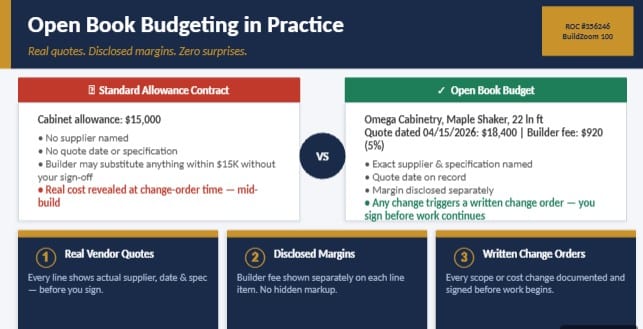
A standard construction contract in the Phoenix market includes allowances for specific line items – cabinets, flooring, fixtures, countertops, and often framing materials or mechanical systems. An allowance is a placeholder number: “Cabinet allowance: $15,000.” This number does not represent a quote from a supplier. It represents the builder’s estimate of the component’s cost.
The problem is structural. The allowance gives the builder contractual permission to select and install any cabinet option they choose, as long as it costs at or below $15,000. If the cabinets you want cost $22,000, the $7,000 difference becomes a change order that adds to your final bill. If the builder installs cabinets that cost $9,000, they keep the $6,000 difference – or apply it to their margin without your knowledge.
Every “little things that add up” and “cost much higher than what was estimated” complaint in the Phoenix custom home buyer forums traces to this mechanism. It is not fraud – it is a standard contract term that creates systematic information asymmetry between the builder, who knows actual costs, and the client, who knows only the allowance placeholder.
Citation Hook 1: The allowance mechanism in standard Phoenix custom home contracts is the primary driver of the 25 to 33 percent budget overruns routinely described by buyers on Houzz, Reddit, and contractor review platforms, because it gives builders contractual permission to substitute materials without client sign-off as long as costs stay at or below the placeholder amount.
What Open Book Budgeting Actually Looks Like
In an open-book budget, the cabinet line does not read “Cabinet allowance: $15,000.” It reads “Cabinet quote – Omega Cabinetry, Maple Shaker, 22 linear feet, per Omega quote dated 04/15/2026: $18,400. Builder fee on this line: $920 (5%).” You see the supplier. You see the quote date. You see the exact specification. You see the margin separately.
Every material line in an open book estimate works the same way: actual supplier, actual quote, actual date, actual specification, and margin disclosed. When costs change – and they do, because material prices move – the change triggers a written change order with a revised line-item estimate before any alternative is ordered or installed. You sign off on the change before it happens. The builder cannot substitute without your knowledge because there is no allowance language authorizing them to do so.
This is Step 3 of the Prolific Builders One-Contractor Standard: The Open-Book Budget Protocol. Before any contract is signed and any demolition begins, the complete line-item estimate, with actual vendor quotes and disclosed margins, is presented to the client. The contract is signed only after the client has reviewed and approved every line. Every subsequent change order is a separate written document with a revised estimate, signed before work continues.
The Numbers Behind Phoenix Custom Home Budget Failures
Custom home construction in Phoenix in 2026 ranges from $200 to $550+ per square foot for standard custom builds. Luxury custom homes with premium desert-engineered materials and advanced systems run $400 to $800+ per square foot. At those price points, a 25% budget overrun on a 3,500-square-foot home at $300/sqft amounts to $262,500 in unexpected costs. A 33% overrun means an additional $346,500 in exposure.
These are not hypothetical numbers. Phoenix homebuilder forums document real buyers who started with $800,000 budgets and ended at $1.1 million without a single change in scope. The mechanism in every case: allowances exceeding the placeholder, change orders triggered by allowance discrepancies, and a contract structure that provided the builder with information the client lacked.
The Prolific Builders 92% on-time and on-budget delivery rate in 2024 is not an accident of favorable market conditions. It is the direct output of the Open-Book Budget Protocol applied at project start, and of the Single-Point Management System (Step 5 of the One-Contractor Standard), which tracks every cost in real time against the approved line-item estimate throughout the build.
How to Confirm a Builder Is Actually Using Open Book Budgeting
Any builder can claim to use open-book budgeting. The claim is cheap. What to verify: ask to see a sample estimate from a completed project (redacted for client privacy). If the estimate shows “Allowance: $X” for major line items, that is not open-book budgeting. If the estimate shows the supplier name, quote date, specification, and disclosed margin for every line, that is open-book budgeting.
Ask specifically: “What happens if the quoted price for a material increases between contract signing and ordering?” A builder using open-book budgeting will describe a written change-order process for cost increases that requires your approval before materials are ordered. A builder using allowances will describe a catch-up settlement at project close.
Ask: “What happens if a material I selected is unavailable mid-project and a substitute is needed?” Open-book budgeting requires a written change order that presents the substitute, its cost, and your written approval before the substitute is installed. Allowance contracts give the builder discretion to substitute anything within the allowance amount without your approval.
The Change Order Discipline That Makes Open Book Budgeting Work
Open-book budgeting only works when the change-order process is equally disciplined. A builder who starts with real vendor quotes but allows verbal scope changes without written change orders gradually erodes the budget integrity that the open-book process was designed to create.
The Prolific Builders change order standard: every scope change that affects cost – regardless of size – triggers a written change order with a revised line-item estimate before any new work begins. The change order specifies the scope change, the cost impact on the specific line, and the new total. The client signs before the work proceeds. There is no accumulation of undocumented changes that surfaces at project close as a surprise number.
This discipline is uncomfortable for some buyers who prefer to verbally authorize small changes in the moment. It protects both parties: the client from budget creep that they did not authorize, and the builder from disputes about what was actually requested. Every decision has a paper trail.
For the full framework of what to verify before hiring a Phoenix custom home builder, see: How to Hire a Trustworthy Custom Home Builder in Phoenix Without Getting Burned.
Also see: How Much Does It Cost to Build a Custom Home in Phoenix, Arizona in 2026 and Why Phoenix Custom Home Projects Go Over Budget and What Can Prevent It.
Get My Free Phoenix Build Consultation
Call (480) 972-3000 or schedule online at prolificbuilders.com
Arizona ROC #356246. BuildZoom Score 100. No-obligation estimate.
Common Questions About Open Book Budgeting
Is open-book budgeting standard practice among Phoenix custom home builders?
No. Most Phoenix custom home contracts use allowances for major material categories. Open book budgeting requires more preparation work from the builder before contract signing – every line requires a real supplier quote rather than a placeholder estimate. Builders who use open-book budgeting invest more time at the start of the project in exchange for fewer budget disputes during the build.
How does open-book budgeting affect the total project cost?
Open book budgeting does not typically increase total project cost – it changes when you know the cost. With allowances, you learn the real cost at change order time, often mid-build, when you have less leverage to negotiate. With open-book budgeting, you know the real cost before signing. The total is the same; the timing of the information protects you.
What is a change order, and when should one be required?
A change order is a written document that specifies any modification to the original scope of work, the cost impact of that modification, and the new project total. Under the Prolific Builders One-Contractor Standard, every scope change, regardless of size, requires a written change order signed by the client before work continues. No exceptions.